OpenAI has launched GPT-6.1 Terra, a large language model designed for fast visual reasoning and computer use. It targets enterprise workflows involving high-volume interactions with screens, forms, and documents. Source: marktechpost.com.
What Is GPT-6.1 Terra?
GPT-6.1 Terra is a reasoning model built for environments with visual input and interactive computer operations. It accepts text and image inputs and returns text-based outputs.
It supports up to 128,000 output tokens, allowing detailed responses without truncation. The knowledge cutoff is June 1, 2026.
It runs only on OpenAI-hosted platforms: the API, ChatGPT Work, and Codex. The model uses closed weights, prioritizing security and performance over transparency.
Performance on Key Benchmarks
OpenAI tested GPT-6.1 Terra on standardized benchmarks for visual reasoning, computer use, and technical tasks.
Agents’ Last Exam (Computer Use)
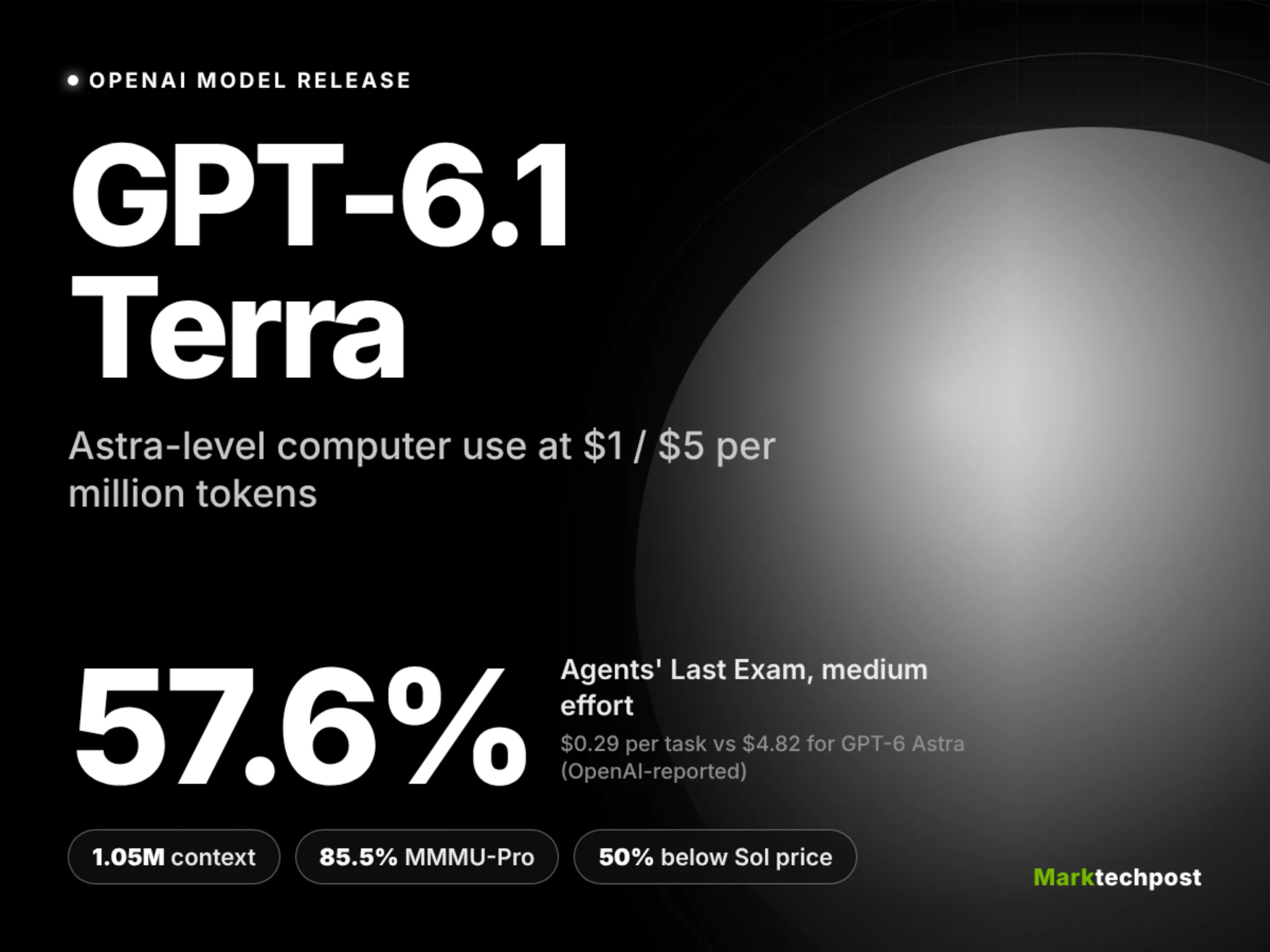
At medium effort, GPT-6.1 Terra scores 57.6% on Agents’ Last Exam v1—matching GPT-6 Astra. This shows strong performance on structured, multi-step tasks.
At max effort, it reaches 60.0%. Claude Opus 5.5 scores 63.2% on the same test. OpenAI says Terra completes these tasks over three times faster than GPT-6 Astra and GPT-6.1 Sol.
On OSWorld 2.1, a real-world software interaction test, Terra scores 66.7% at medium and 74.2% at max. This improves over GPT-5.6 Terra’s peak of 57.1%, showing better navigation of complex interfaces.
Visual Reasoning (MMMU-Pro)
On MMMU-Pro, a visual understanding benchmark, Terra scores 85.5% at max effort. GPT-6.1 Sol scores 86.3% and GPT-6 Astra 86.7%. Terra is within 1.2 points of Astra.
Coding and Technical Tasks
On Terminal-Bench 4.0, Terra solves 50.3% of tasks at max effort—up from 21.5% for GPT-5.6 Terra. It still trails GPT-6.1 Sol (55.9%), GPT-6 Astra (58.2%), and Claude Sonnet 5.5 (70.6%).
On Terminal-Bench-Science 0.1, Terra scores 58.3% at $4.15 per task. This beats GPT-6.1 Sol’s 57.0% at $5.47. Claude Opus 5.5 with fallbacks scores 63.3% at $23.21.
OpenAI recommends GPT-6.1 Sol or GPT-6 Astra for complex coding tasks. GPT-6.1 Terra is best for routine automation, not advanced software development.
Cost and Availability
Standard pricing is $1 per million input tokens and $5 per million output tokens. Cached input costs $0.05 per million tokens.
Batch and Flex plans offer 50% lower rates. Fast mode costs twice as much as standard.
For prompts over 272K input tokens, input costs double and output costs increase by 1.5x.
Compared to GPT-6.1 Sol’s $2/$10, Terra is half the price. It is one-tenth the cost of GPT-6 Astra’s $10/$50. Claude Opus 5.5 is priced at $4/$20.
GPT-6.1 Terra is available in ChatGPT for Plus, Pro, Enterprise, and Edu users in ChatGPT Work and Codex.
Key Comparisons with Competitors
- It matches GPT-6 Astra on Agents’ Last Exam at $0.29 per task—half the cost of Astra’s $4.82.
- It performs within 1.2 points of Astra on MMMU-Pro, a visual reasoning test.
- Coding performance lags behind leading models, especially in complex technical tasks.
- Cost efficiency makes it ideal for teams automating routine screen and document interactions.
Limitations and Open Questions
While GPT-6.1 Terra performs well in visual and computer use, its coding capabilities remain limited. On adversarial prompts, error rates drop from 53.6% to 16.7% at low effort and to 4.3% at max effort—showing improved reliability.
Performance data comes from OpenAI’s internal benchmarks. Parameters and hardware are not disclosed. All scores are self-reported.
OpenAI has not evaluated Terra’s real-world performance in enterprise workflows. It is not designed for high-stakes decisions or complex code generation.
For teams automating forms, documents, or screen interactions, GPT-6.1 Terra offers a reliable, cost-effective solution. It should not be used in precision, security, or advanced technical tasks without further validation.
Learn more in the official OpenAI announcement at openai.com. API details are at developers.openai.com. Compare GPT-6.1 Sol at developers.openai.com.
Sources & further reading
Featured image: OpenAI Launches GPT-6.1 Terra, Halving GPT-6.1 Sol’s API Price for Agent Work. Via original publisher. Image source