Over the past 15 months, one of the country’s worst marine environmental disasters has been unfolding in South Australia.
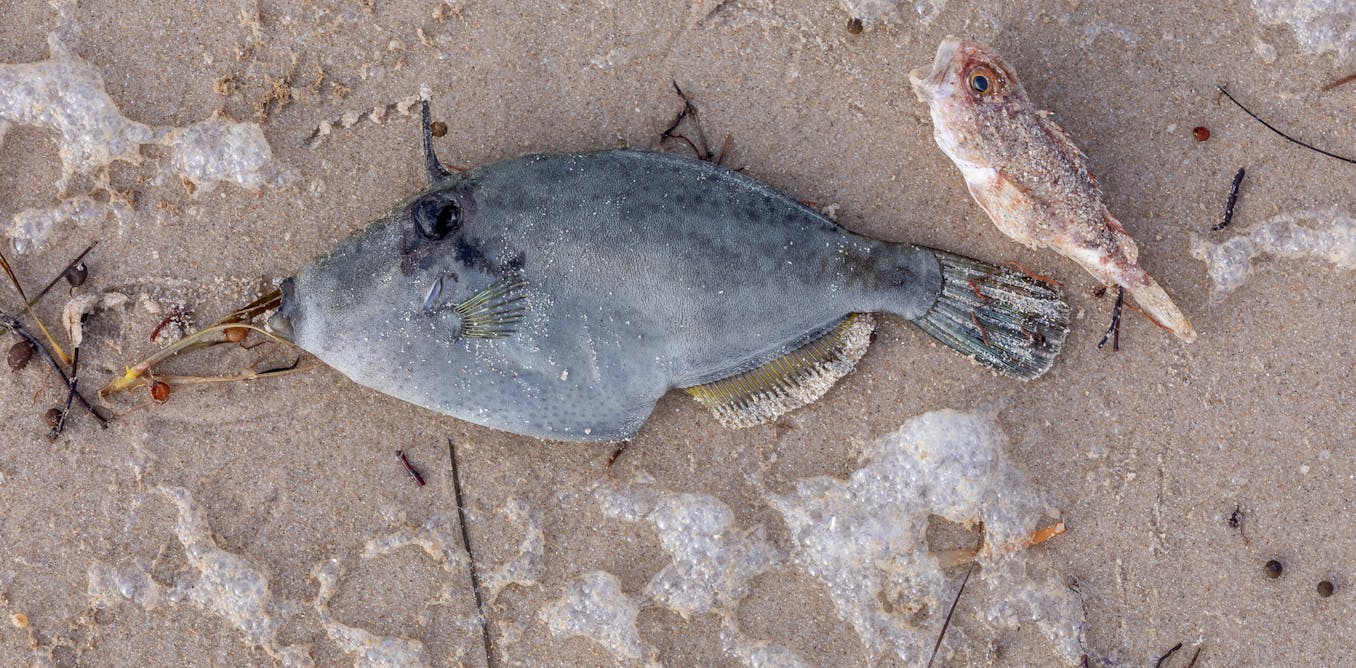
A harmful algal bloom expanded in many coastal seas, killing thousands of fish, birds, shellfish and marine mammals. Even iconic species such as giant cuttlefish and seadragons have washed up dead on beaches.
These blooms happen when particular species of microscopic algae accumulate in a body of water. Several hundred species of microalgae produce toxins that, in high concentrations, can be harmful to humans and deadly to marine creatures.
Our new research shows Karenia cristata, the rare microalgal species behind this catastrophic bloom, is among the most toxic species to marine life ever studied. It’s capable of killing zooplankton, a type of small marine animal, in concentrations of just five cells per millilitre of seawater.
A marine disaster
In March 2025, dozens of surfers and swimmers fell ill after being exposed to water or seafoam on the Fleurieu Peninsula, south of Adelaide.
Local residents and tourists reported respiratory symptoms such as coughing and shortness of breath, as well as skin and eye irritation.
Reports of dead or dying marine creatures followed. And water testing by authorities found the first signs of an algal bloom.
In the following months, the algal bloom spread across SA’s two main gulfs, the Gulf St Vincent and Spencer Gulf. It has proved devastating for the state’s marine ecosystems, aquaculture industries and coastal communities.
The detection of brevetoxins in shellfish forced local oyster and mussel farmers to stop harvesting for up to eight months. Hundreds of coastal businesses, such as recreational fishing charters and wildlife tour operators, lost significant income.
Read more:
Mystery solved: our tests reveal the tiny algae killing fish and harming surfers on SA beaches
What is Karenia cristata?
K. cristata is an extremely rare microalgal species. Before this bloom, it has only ever been found in two locations: South Africa and an island off the coast of Newfoundland.
There are many different species of Karenia. But they’re often hard to distinguish as their cells have a similar size and shape. This is a problem because Karenia species that look similar can produce completely different toxins, or no toxins at all.
In our new study, we used a method called scanning electron microscopy to get an extremely close-up view of K. cristata cells. This allowed us to compare them with the cells of other types of Karenia.
We also developed several new molecular genetic methods to measure the number and distribution of Karenia during the SA bloom. These genetic methods allowed us to easily distinguish between different Karenia species.
We found the only other Karenia species known to produce brevetoxins, K. brevis, was not in the SA bloom. We also found both K. cristata and K. brevis produced similar concentrations of brevetoxins, but with a different chemical makeup.
We found K. cristata was the dominant Karenia species. It was in 90% of the samples we tested, and remained in high concentrations over time. We also identified four other Karenia species in our samples.
Read more:
How could we clean up the algal bloom?
Why is this algae so lethal?
Our latest research suggests the microalgae that caused SA algal bloom is among the deadliest species of its kind, in terms of impact on marine life.
Our team of 25 scientists took a closer look at laboratory-grown strains of K. cristata. To do this, we hand-picked individual cells of microalgae from seawater using ultrafine glass pipettes. We then grew them in bacteria-free, nutrient-rich seawater and made sure the temperature and amount of light stayed the same.
Using these lab-grown cells, we conducted three different experiments to observe how Karenia toxins affect the cells of fish and invertebrates – tiny marine animals that don’t have a backbone such as rotifers, a type of small zooplankton, and larval crustaceans.
The results were startling. K. cristata killed half the invertebrates we studied, even in extremely low concentrations of only five cells per millilitre – or 5,000 cells per litre – of seawater. This makes it more deadly to invertebrates than any other species of toxin-producing algae tested using this same method. The algae had a similar affect on lab-grown fish gill cells.
Compared with our experiments, K. cristata was present in higher concentrations in the waters around SA during the latest algal bloom. In August and September 2025, we routinely recorded concentrations higher than one million cells per litre of seawater off the coast of Adelaide.
This may explain why this bloom was so catastrophic.
Where to from here?
Until now, we thought an algal bloom of this scale could only develop in the warm waters off the southeastern United States. There, harmful algal blooms caused by the K. brevis microalgae are fairly common.
But our research shows other coastal areas around the world could also be at risk – including those with cooler waters.
We urgently need more research to understand the conditions that allow K. cristata to thrive and produce toxins in such high concentrations.
This will allow us to develop monitoring programs that not only detect harmful algae, but also identify which species may be most deadly. Only then can we protect our coastal ecosystems, industries and communities from another marine disaster.