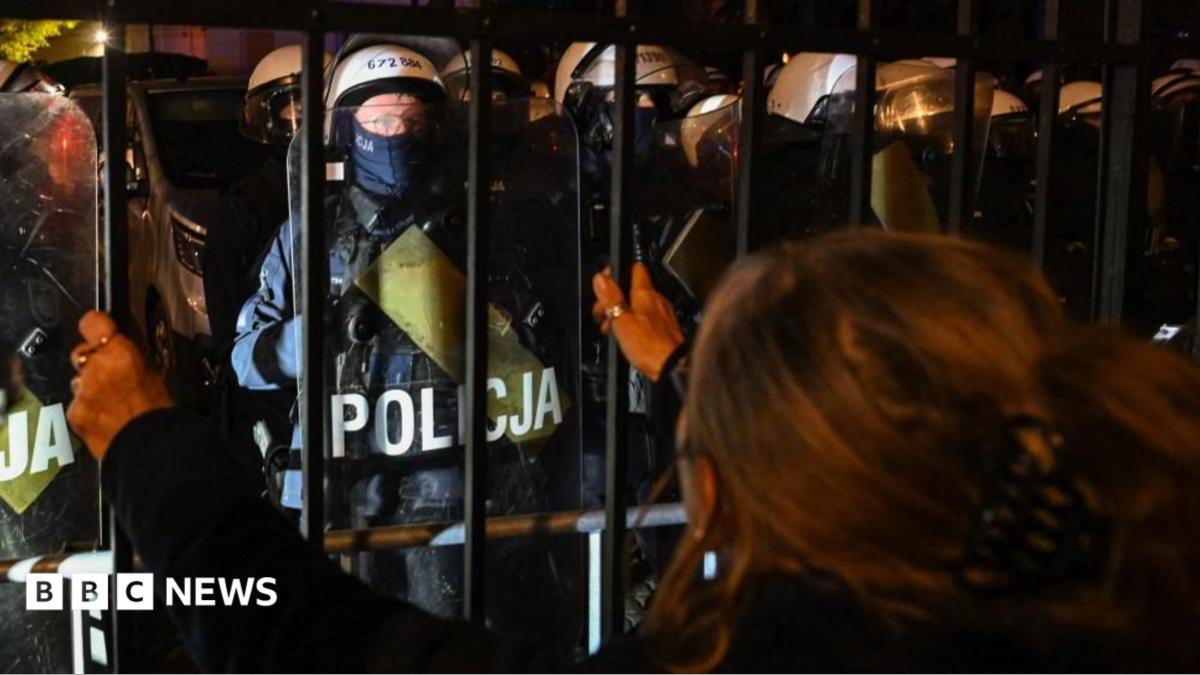
Police deployed at Poland’s Constitutional Court amid escalating conflict between the government and top judges. Source: bbc.co.uk.
What Happened
Riot police were sent to Warsaw’s Constitutional Court after Justice Minister Waldemar Żurek announced plans to bring criminal charges against President Bogdan Święczkowski and Vice-President Bartłomiej Sochański.
The minister claimed the judges blocked new appointments, undermining the court’s legitimacy and independence.
The Constitutional Court responded online, stating both judges remain legally appointed and that any move to remove them is a ‘crime of a coup d’etat’.
Protesters gathered outside, mostly supporting the judges. Police blocked entry to the building to prevent unrest.
Key Facts
- The Constitutional Court is Poland’s highest judicial body and reviews the legality of laws.
- Prime Minister Donald Tusk says the actions are necessary to restore the rule of law after years of judicial overreach by the Law and Justice (PiS) party.
- President Karol Nawrocki, a PiS ally, entered the court and has refused to swear in five judges elected by parliament since March.
- The court insists the two judges targeted are still legally appointed and that their removal has no legal basis.
- The Venice Commission, the Council of Europe’s constitutional advisory body, has urged Nawrocki to swear in the new judges to protect judicial independence.
Background: How the Conflict Developed
Since 2015, the PiS-led government has appointed judges to gain a majority in the Constitutional Court.
European courts found three of these appointments invalid because they duplicated existing positions, violating judicial appointment rules.
These rulings concluded the court was no longer independent or impartial, damaging democratic principles.
As a result, the Tusk government has stopped publishing court rulings, claiming they lack legal validity.
Why It Matters
This crisis shows a serious threat to Poland’s judicial independence and the rule of law.
It draws international attention and raises concerns about political manipulation of legal institutions.
Experts warn that prosecuting judges for refusing to allow new appointments could set a dangerous precedent, weakening the judiciary’s role as a check on power.
Reactions and Criticisms
Lawyer Marcin Matczak, a critic of PiS reforms, says the suspension has no legal basis.
He warns the action will destroy the court’s credibility and trigger long-term backlash against the rule of law.
Matczak wrote: ‘Today’s action at the Constitutional Court, in my opinion, buries this body and the issue of the rule of law for two decades.’ He added that images of armed police and ministers removing court leaders by decree signal political overreach.
Some of Tusk’s supporters say the move is politically driven, aimed at boosting his image ahead of next year’s elections.
Limitations and Open Questions
Polish law does not allow the justice minister to remove a court president by decree.
It’s unclear if criminal charges will be filed or if the court can function under current pressure.
International observers are divided: some see the actions as justified; others view them as a clear breach of democratic norms.
What to Watch Next
Key events include whether the five new judges will be sworn in, the progress of any criminal cases, and statements from the Venice Commission.
Protests and political debates are likely to continue, keeping this issue central to Poland’s democratic future.
Source: BBC News, original article
Sources & further reading
Featured image: A woman looks at police officers standing guard outside Poland's Constitutional Tribunal in Warsaw. Photo: 30 October 2026. Via original publisher. Image source