A fake government app in Italy has been found to deliver spyware to asylum seekers, raising serious concerns about digital surveillance and oversight. Source: securityaffairs.com.
What Happened
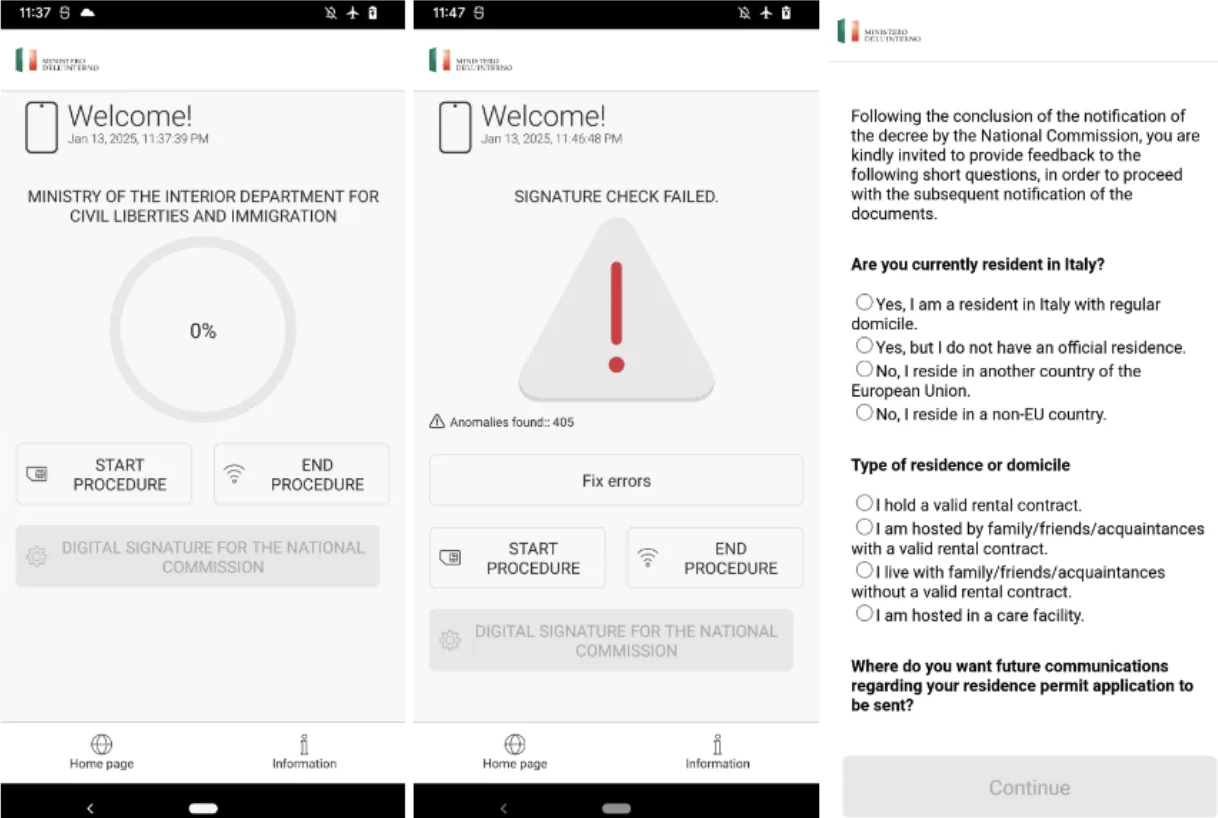
An Android app named FirmaDigitale claimed to provide updates on asylum seekers’ protection status. It was presented as an official tool from Italy’s Interior Ministry.
Instead, it delivered Morpheus spyware—software designed to monitor and extract private data from mobile devices. The app was distributed through firmadigitale.assistenza-mobile[.]it, a site mimicking Poste Italiane, Italy’s main postal service.
The site has been unreachable since 2025. The app still circulates in some digital networks. Police deny involvement. Poste Italiane has not responded.
Key Facts
- The spyware can access the microphone, intercept calls, record screens, and track device activity.
- It retrieves contacts, call logs, messages, and files—giving full access to personal data.
- It is linked to IPS, a company that supplies surveillance tools to Italian prosecutors, police, and intelligence agencies.
- There is no public record of who ordered the operation or who was targeted. Oversight is absent.
- At least five activists have received spyware links recently. No direct link to FirmaDigitale has been confirmed.
How the Spyware Works
Morpheus uses social engineering—deception, not technical exploits—to trick users into installing it.
It displays the Interior Ministry logo and references a legal decree. This makes it appear official, especially to users with limited digital trust or access.
Researchers at Osservatorio Nessuno first found Morpheus in a fake Fastweb app in April 2026. It has since appeared in apps impersonating TIM, Iliad, PosteMobile, and WindTre.
One feature allows it to hijack WhatsApp through a fake biometric prompt. This bypasses user authentication and gives remote access to messages and calls.
Why This Case Is Troubling
It targets asylum seekers—already facing systemic discrimination and limited legal and digital support.
These individuals rely on digital tools for communication and legal updates. A fake app exploiting their trust undermines their privacy and safety.
Experts say this shows a growing trend: low-cost, socially engineered spyware that exploits human vulnerability. According to Kristina Balaam of Citizen Lab, such tools are cheaper than zero-click spyware and still effective.
‘We are faced with yet another example of low-cost spyware that exploits vulnerability and suffering,’ said a spokesperson for Osservatorio Nessuno. ‘This case is particularly cruel because it leverages systems that are already discriminatory and hostile. The responsibility lies in many quarters: from the complete lack of Italian or European regulation regarding the proliferation of such companies, to a total absence of transparency and constraints—including ethical ones—on these types of operations.’
Legal and Oversight Gaps
Italian law allows surveillance beyond mafia and terrorism—covering corruption and many ordinary crimes. This broad scope enables wide use of spyware with little restriction.
There is no requirement to notify individuals when surveillance ends. Collected data may remain in public prosecutor archives indefinitely.
Lawyer Giovanni Battista Gallus says Italy lacks a law limiting what spyware can do. Data collected may be archived without disclosure or deletion. In the eSurv case, a company stored data on its own servers. The case is still ongoing.
Magistrates’ association vice president Marcello De Chiara supports spyware use but wants tighter rules. He calls for a national register, clear ownership, and greater transparency.
Industry Trends
Nine established firms reported €214.4 million in revenue in 2024. Italy supplied 72.8% of that revenue among the five firms that disclosed geography.
From 2021 to 2025, spyware operations rose from 2,894 to 5,611—almost a 94% increase. Of those, 2,930 were linked to mafia cases, 2,618 to ordinary crimes, and 63 to terrorism.
Germany conducted 91 spyware operations in 2024 and carried out 57. Italy’s total is not broken down, but the scale suggests significant growth. Interception spending reached about €299 million in 2025—despite a national price list meant to cut costs.
Open Questions
There is no official report linking the FirmaDigitale app to actual surveillance of asylum seekers. The connection remains unverified.
Activists have reported receiving spyware links. But no direct link has been confirmed to the fake app. This makes it unclear if this is part of a broader pattern or a single incident.
It is unknown whether the operation was authorized by a legal body or falls under unregulated practices. No formal audit or oversight process exists.
Italy has no quality check for spyware tools. Authorities lack the skills to verify software before use. This means tools may contain backdoors or evade detection.
Victims may never know they were surveilled. The law does not require notification when an investigation ends. Data may remain stored indefinitely. As Gallus concludes: ‘Those who are spied upon may never even find out. In fact, there is no obligation to notify an individual that they have been subjected to surveillance once an investigation is closed. Furthermore, while the surveillance tools must be deactivated at the end of an operation, the material collected is not automatically deleted; instead, it may remain stored in the public prosecutor’s archives.’
What to Watch Next
Legal proceedings in the eSurv case may reveal how surveillance tools are used and stored.
Public inquiries into companies like IPS could expose broader industry practices.
Activists and journalists may report more social engineering attacks in the coming months. Italy’s lack of a comprehensive law on digital surveillance remains a key gap. Without clear rules, oversight is likely to stay weak.
For more on digital surveillance in Italy, see IrpiMedia’s investigation. For broader context on spyware use, visit SecurityAffairs.
Sea-Watch’s Giorgia Linardi previously reported zero-click surveillance in 2021. While not directly tied to this case, it shows a pattern of surveillance targeting humanitarian actors—suggesting a wider ecosystem of digital monitoring.
Sources & further reading
Featured image: Morpheus spyware. Via original publisher. Image source