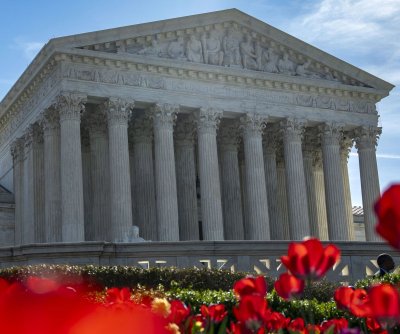
The Supreme Court voted 6-3 to eliminate one of Louisiana’s predominantly Black congressional districts. Photo by Bonnie Cash/UPI | License Photo
April 29 (UPI) — The U.S. Supreme Court on Wednesday struck down Louisiana’s newly drawn congressional map as an unconstitutional racial gerrymander in a ruling that Democrats and civil rights advocates say gutted a key provision of the landmark Voting Rights Act.
The 6-3 decision is expected to eliminate one of the two predominantly Black congressional districts established by redistricting after the 2020 census.
Supporters of the redrawn map said it complied with Section 2 of the Voting Rights Act, which bars election practices that dilute minority voters’ power, including by packing them into too few districts or spreading them across too many.
Justice Samuel Alito, writing for the majority, described Louisiana’s map as an “unconstitutional gerrymander.”
“When §2 of the Act is properly interpreted, it imposes liability only when circumstances give rise to a strong inference that intentional discrimination occurred,” he wrote.
The ruling weakens the landmark Voting Rights Act passed in 1965 to limit racial discrimination in voting.
According to Alanah Odoms, executive director of the American Civil Liberties Union of Louisiana, Section 2 had allowed plaintiffs to challenge maps by showing that district lines diluted minority voting power under tje totality of the circumstances, including a state’s history of racial discrimination.
Wednesday’s ruling means courts cannot order new congressional districts drawn unless plaintiffs can prove intentional discrimination, she said.
“States can offer any reason at all, including protecting incumbents, to justify discriminatory acts now,” she said in a recorded statement.
Odoms described the ruling as the most recent in a series from the high court meant “to dismantle every tool Black Americans fought, bled and died for.”
The Supreme Court dealt the act a blow in 2013 when it struck down a core provision requiring federal oversight of states with a history of voting discrimination.
With the new ruling by the high court, Republican lawmakers could have an easier time redrawing state maps to more closely align with their party. Some had said they would move forward on redrawing their maps depending on how the Supreme Court would rule in the case.
Mississippi Gov. Tate Reeves last week said that he’d call a special session 21 days following the high court’s ruling to consider the state’s electoral maps.
“First Dobbs. Now Callais. Just Mississippi and Louisiana down here saving our country!” Reeves, a Republican, said online, while celebrating Wednesday’s decision.
Alabama Attorney General Steve Marshall said in a statement that his office would “act as quickly as possible to apply this ruling to Alabama’s redistricting efforts and ensure that our congressional maps reflect the will of the people, not a racial quota system the Constitution forbids.”
President Donald Trump called the ruling “a BIG WIN for Equal Protection under the Law.”
“Thank you Justice Samuel Alito for authoring this important and appropriate Opinion,” he said on his Truth Social platform.
Democrats and voting rights advocates are describing the decision as a major rollback of civil and voting rights, saying it undermines decades of hard-fought progress in strengthening the political power of Black and Latino communities.
The Congressional Black Caucus said the legitimacy of the high court “has been deeply undermined by this decision.” The African American Mayors Association said they were witnessing “a targeted, systematic effort to roll back rights and freedoms that our ancestors fought and died to secure” and that the effort will continue.
“Today’s decision is a devastating blow to what remains of the Voting Rights Act, and a license for corrupt politicians who want to rig the system by silencing entire communities,” NAACP President and CEO Derrick Johnson said in a statement.
“The Supreme Court betrayed Black voters, they betrayed Americans and they betrayed our democracy.”
Justice Elena Kagan, one of the three dissenters who make up the bench’s liberal justices, said such intentional discrimination is hard to prove and that Wednesday’s decision serves to “eviscerate the law.”
“Under the Court’s new view of Section 2, a State can, without legal consequence, systematically dilute minority citizens’ voting power,” she wrote in her strongly worded dissent.
She described the majority opinion as green-lighting redistricting plans that “will disable minority communities” from electing representatives of their choice.
The Voting Rights Act “was born of the literal blood of Union soldiers and civil rights marchers. It ushered in awe-inspiring change, bringing this Nation closer to fulfilling the ideas of democracy and racial equality,” she said, adding that only Congress, and not the high court, has the ability to determine if it is no longer needed.
She said that with the ruling, Section 2 of the Voting Rights Act is “all but dead.”
“The decision here is about Louisiana’s District 6. But so too it is about Louisiana’s District 2 … And so too it is about the many other districts, particularly in the South, that in the last half-century have given minority citizens, and particularly African Americans, a meaningful political voice,” she said.
“After today, those districts exist only on sufferance, and probably not for long.”
Louisiana Secretary of State Nancy Landry said she was not at liberty to comment on the decision as the case remains active litigation, and has been remanded for proceedings back to the Western District.
“My lawyers are currently analyzing the opinion,” she said in a statement.
Meanwhile, the state’s attorney general, Liz Murrill, said the Supreme Court had ended “Louisiana’s long-running nightmare of federal courts coercing the state to draw a racially discriminatory map.”
It’s unlikely the ruling will affect Louisiana’s congressional primaries later this year, as early voting begins May 16.

Artemis II pilot Victor Glover (L) and mission specialist Christina Koch meet with President Trump in the Oval Office of the White House on Wednesday. Photo by Graeme Sloan/UPI | License Photo