Etsy has introduced new rules to limit the use of artificial intelligence in product listings. The changes aim to reduce what the platform calls ‘AI slop’—items that appear to be generated by AI but lack authenticity. Source: theverge.com.
What Changed on Etsy
The platform updated its seller guidelines to require at least one unedited photo of an item against a real background. This photo must show the actual product in a genuine setting.
Other photos in a listing can be edited using software or AI tools, as long as the final image accurately reflects what a buyer will receive. The company says this ensures transparency and prevents misleading visuals.
When sellers upload images, Etsy may detect AI-generated content. If so, a pop-up appears asking whether the image was created with AI. Sellers must respond to this prompt to avoid violations.
Examples of Prohibited Content
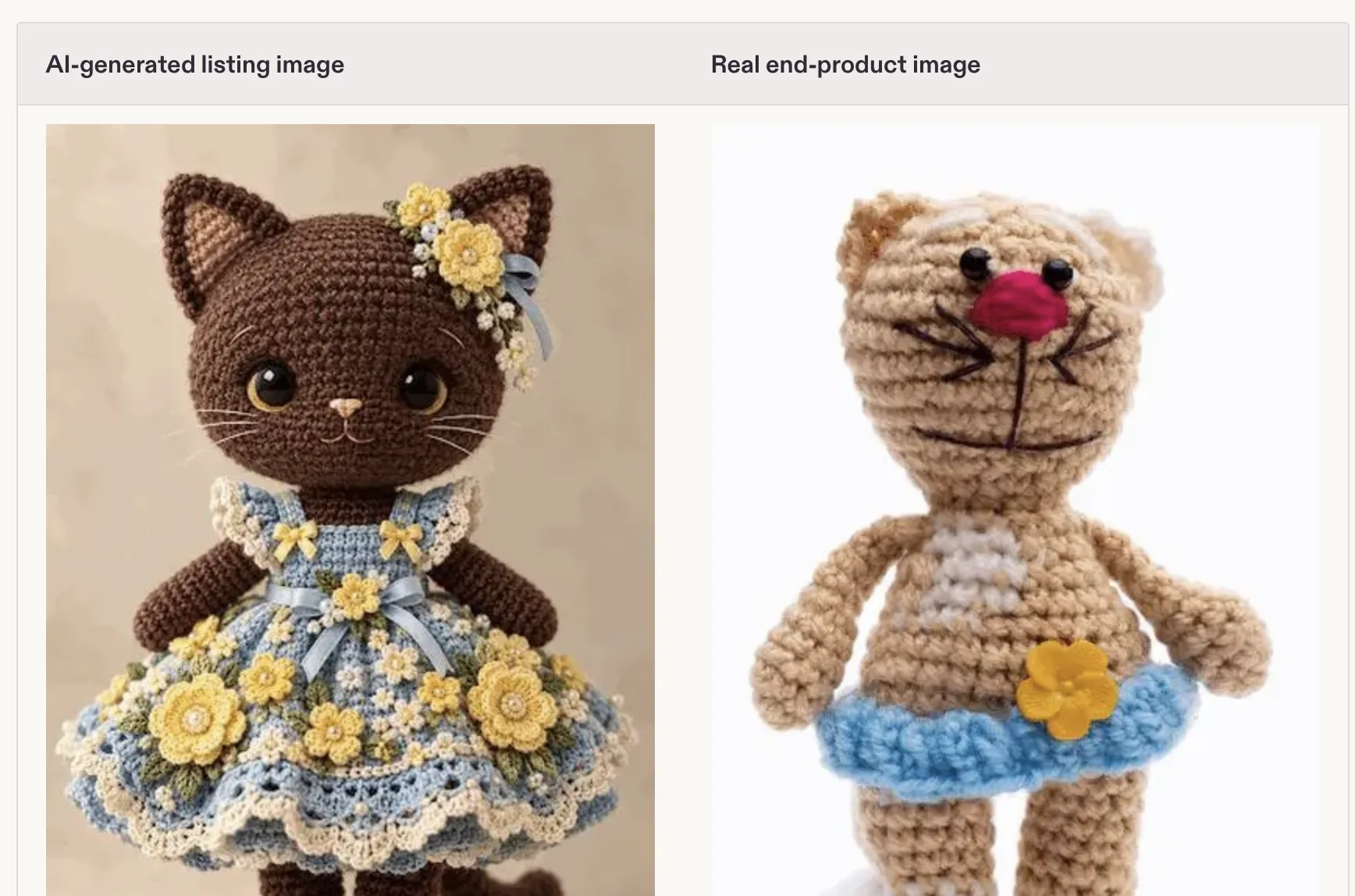
- A stuffed cat with a perfectly smooth, unrealistic fur texture.
- An item shown in a studio setting with no real background.
- Photos that exaggerate features or distort the product’s appearance.
Etsy has shared examples to illustrate what constitutes misleading imagery. These cases show how AI-generated visuals can mislead buyers about the physical product.
AI-Generated Guides Are Restricted
Sellers offering functional guides—such as recipes, patterns, or instructions—must ensure the content is their original work. AI-generated instructions are not allowed.
These guides must be backed by an actual result. For example, a pattern for a quilt must be applied and shown in a real-world setting. Sellers must provide evidence that the guide was used to create a tangible product.
Bot-generated listings are no longer permitted. This includes automated posts or listings created without human involvement.
AI Art Is Allowed, With Disclosure
Art created with AI can still be sold on Etsy, but sellers must clearly state that the artwork was generated using artificial intelligence.
For instance, a digital painting must include a label like ‘AI-generated artwork’ in the listing description. This transparency helps buyers understand the origin of the item.
The policy does not ban AI use entirely, but it enforces accountability. Sellers are responsible for ensuring their listings are truthful and not deceptive.
Why This Matters
Many buyers report difficulty distinguishing between AI-generated and human-made items. Etsy says this confusion undermines trust in the platform.
Sellers also express concern that their original work might be mixed with AI-generated content. The new rules aim to protect creators and maintain marketplace integrity.
While the policy is specific, it does not cover all AI applications. For instance, AI tools used to enhance design or suggest ideas are not explicitly banned.
Limitations and Open Questions
It remains unclear how Etsy will detect AI-generated images. The platform relies on automated tools, which may not always be accurate.
There is no defined penalty for violating the rules, only the possibility of a refund if a buyer reports a significant mismatch between listing and delivery.
Some sellers may struggle to meet the new standards, especially those who rely on AI tools for design or content creation.
The policy applies to all new listings and may be rolled out gradually. Updates are expected to be detailed in the Etsy Seller Handbook.
These changes reflect a broader trend in e-commerce: platforms are introducing clearer rules to ensure authenticity and transparency in digital marketplaces.
Sources & further reading
Featured image: original publisher image. Via original publisher. Image source