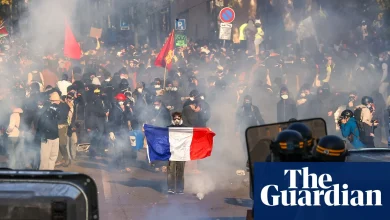
France’s bond and stock markets plunged after violent protests over the weekend. Public buildings were set on fire and hundreds of shops looted in cities like Paris, Bordeaux, Nice, and Marseille. Source: theguardian.com.
What Happened
Protests began as peaceful demonstrations over poor school conditions and rising living costs. Tens of thousands gathered to demand more teachers and better school repairs.
Clashes with police erupted in several cities. Violence escalated, with reports of looting and arson. The unrest damaged public infrastructure and raised concerns about social stability.
Market Reactions
The 10-year French bond yield rose to 4.94%, a 16 basis point increase. This pushed borrowing costs close to a 24-year high.
The two-year bond yield climbed nine basis points to 3.64%. The 30-year bond, a key benchmark, rose ten basis points to 5.46%.
The gap between French and German 10-year bond yields widened to its highest level in 14 years. This shows investors now see higher risk in French debt.
Investor Concerns
Goldman Sachs says sovereign risk is back in focus. The bank warns that France’s fiscal challenges are harder now than in 2011–15.
Deutsche Bank’s Jim Reid says investors won’t feel comfortable buying French bonds. France faces a tough fiscal situation and a 2027 election that could add political risk.
Saxo UK’s Neil Wilson says the unrest makes it harder to cut spending. Such cuts are needed to reduce the deficit and stabilize finances.

France’s Fiscal Position
France’s debt-to-GDP was 115.6% in 2025. Its budget deficit was 5.1%. This compares to the UK’s 94.3% debt-to-GDP and 4.3% deficit.
The government plans a budget with cuts to pensions and departmental spending—excluding defence. These cuts aim to reduce the deficit.
But political pressure may stop these reforms. If they fail, borrowing costs could rise further and debt could grow.
Broader Market Effects
The euro fell to a 17-month low against the pound. It also dropped 0.4% against the US dollar.
France’s Cac 40 index dropped 1.4%. French bank stocks, including Société Générale and BNP Paribas, fell sharply.
Italy’s FTSE Mib dropped 1.6%. Spain’s Ibex declined 1.9%. All European markets weakened.
Why This Matters
Market reactions show investors see real risks to France’s fiscal stability. The unrest signals a loss of policy credibility.
Investors now monitor both economic data and social events. The French government faces strong pressure to act, even as public dissent grows.
France is not alone in facing fiscal and political challenges. But this unrest shows how quickly social events can impact financial markets.
Sources & further reading
Featured image: original publisher image. Via original publisher. Image source