

Saudis down drone targeting foreign embassies, defense ministry says
Saudi forces intercepted a drone targeting Riyadh’s Diplomatic Quarter housing foreign embassies, the defense ministry said Friday.
The “hostile drone” was downed “during an attempt to approach the Diplomatic Quarter”, the ministry posted on X.
Three more drones were intercepted elsewhere in Saudi Arabia around the same time, the ministry said.
Trump: “Watch what happens” to Iran’s regime Friday
President Trump had more strong words for Iran’s leaders early Friday and took a swipe at The New York Times as well.
He posted on his Truth Social outlet that the U.S. is “totally destroying the terrorist regime of Iran, militarily, economically, and otherwise, yet, if you read the Failing New York Times, you would incorrectly think that we are not winning. Iran’s Navy is gone, their Air Force is no longer, missiles, drones and everything else are being decimated, and their leaders have been wiped from the face of the earth. We have unparalleled firepower, unlimited ammunition, and plenty of time – Watch what happens to these deranged sc–mb-gs today. They’ve been killing innocent people all over the world for 47 years, and now I, as the 47th President of the United States of America, am killing them. What a great honor it is to do so!”
Explosions heard in central Dubai
Explosions rattled buildings in Dubai and a large cloud of smoke hung over a central area of the Middle East financial hub on Friday, Agence France-Presse reporters said.
An AFP correspondent felt the building shake and heard a huge explosion.
Sirens could be heard coming from the direction of Sheikh Zayed Road, the United Arab Emirates city’s main artery.
A drone fell on Thursday near Dubai’s financial district after Iran threatened to hit economic institutions, prompting some companies to evacuate staff.
The UAE has come under repeated Iranian fire during the Middle East war, with Dubai’s airport, one of the world’s biggest, repeatedly targeted as well as its port and luxury real estate including the Palm Jumeirah.
French soldier killed in Iraq, Macron says
A member of the French army was killed in an attack in the Erbil region of northern Iraq, French President Emmanuel Macron said in a post on X.
Macron named the deceased soldier as Chief Warrant Officer Arnaud Frion. He said several others were wounded in an attack Macron called “unacceptable.”
Some French forces are present in Iraq as part of a yearslong anti-Islamic State mission.
Macron didn’t specify who is believed to have carried out the attack. But a U.S. base in Erbil has faced incoming fire in the past, likely part of Iran and its allied militant groups’ retaliatory strikes against American bases.
Earlier Thursday, a drone attack targeted an Italian base in Erbil, Iraq, according to Foreign Minister Antonio Tajani. He said the Italian soldiers at the base were safe.
Trump administration allows purchase of Russian oil already at sea
The U.S. is temporarily greenlighting the purchase of Russian oil that’s already at sea, Treasury Secretary Scott Bessent said Thursday, the Trump administration’s latest move to loosen the wartime sanctions that restricted Russia’s oil industry as the world grapples with high oil prices.
The sanctions relief will last one month, and applies to petroleum products from Russia that were loaded onto ships on or before Thursday, according to documents issued by the Treasury.
Bessent said the move will “permit countries to purchase Russian oil currently stranded at sea.”
“This narrowly tailored, short-term measure applies only to oil already in transit and will not provide significant financial benefit to the Russian government, which derives the majority of its energy revenue from taxes assessed at the point of extraction,” he wrote on X.
Last week, the Treasury issued a separate license that allowed India to buy oil and petroleum products from Russia for one month. The move was controversial, with congressional Democrats arguing it could enrich Russian President Vladimir Putin’s government and undermine sanctions designed to make it harder for Russia to finance its war against Ukraine.
U.S. military evacuates 19 injured personnel from Middle East
The U.S. carried out another military evacuation flight on Thursday, flying about 19 injured service to Germany, officials familiar with the matter told CBS News. The plane flew from Saudi Arabia, stopped in Oman, then traveled to a U.S. base in Germany near a military hospital.
Among the evacuees were two service members who were injured when a drone exploded next to their vehicle.
The military previously evacuated dozens of service members who were injured in a strike on a U.S. facility in Kuwait that killed six people. About 20 service members arrived Tuesday at Landstuhl Regional Medical Center in Germany with injuries the military designated as “urgent,” including traumatic brain injuries, memory loss and concussions, sources told CBS News.
Spokespeople at Landstuhl declined to comment on the most recent evacuation Thursday.
U.S. fired at Iranian vessel that approached aircraft carrier, officials say
An Iranian vessel sailed too close to the USS Abraham Lincoln aircraft carrier last week, and the U.S. fired at the vessel, according to two U.S. officials briefed on the matter who spoke to CBS News under condition of anonymity because they were not authorized to speak publicly.
The officials said a U.S. Navy vessel attempted to fire on the Iranian vessel using its 5-inch, 54-caliber Marck-45 gun, a fully automated naval cannon that is mounted to the forward deck of Navy destroyers and cruisers and has served as the fleet’s standard deck gun since the early 1970s.
While it’s not known which naval vessel fired on the Iranian ship, the officials said it missed multiple times. The status of the Iranian ship and its crew is not known.
Netanyahu says Israel killed top Iranian nuclear scientist
Israeli attacks killed one senior scientist involved in developing nuclear weapons and hit several other Iranian scientists, Israeli Prime Minister Benjamin Netanyahu said as he took questions Thursday from reporters for the first time since this war began Feb. 28.
Netanyahu also condemned Iran’s new supreme leader, Ayatollah Mojtaba Khamenei, calling him a “puppet of the Revolutionary Guards.” And he said the U.S. and Israel’s strikes against Iran were intended to give Iranians “the space needed to go out to the streets,” suggesting a “new path of freedom” could open up for the Iranian people.
“But at the end of the day, it depends on you. It is in your hands,” Netanyahu said.
The Israeli leader and President Trump have cast the war as an opportunity for the Iranian people to overthrow the country’s government — though their messages on whether regime change is one of the aims of the war have been mixed.
Israel has long been suspected of targeting Iranian nuclear scientists.
Iran has enriched uranium to near weapons-grade levels in recent years, though U.S. intelligence agencies assessed last year that the country was not actively pursuing a nuclear weapon. Iran has long insisted that its nuclear program is intended solely for peaceful purposes.
CBS/AP
Iranian oil exports up since last month, even as war disrupts Strait of Hormuz, shipping data shows
The severe shipping disruptions wrought by the U.S.-Iran war have not stopped Iran from exporting oil, according to new data from maritime tracking firm TankerTrackers.com.
Iran exported just over 1 million barrels of crude oil per day in the first nine days of March, up 30% from the same period in February, before the war began, according to TankerTrackers.com. The firm cautioned that it is taking longer to confirm data due to cloudy weather and delays in releasing satellite images.
Commercial traffic through the Strait of Hormuz has slowed to a crawl since the war began, making it all but impossible for Arab states to export oil through the waterway, which typically carries around 20% of the world’s supply. But some Iranian and Chinese ships have continued to make it through the strait.
U.S. military plane crashes in Iraq, status of crew is unknown
An American military aerial refueling tanker that was involved in the U.S. military operation in Iran crashed in western Iraq on Thursday, according to multiple U.S. officials who spoke to CBS News.
Recovery efforts are underway in the area where a Boeing KC-135 Stratotanker crashed. The status of the crew is unknown at this time.
U.S. Central Command said the incident was not caused by hostile fire or friendly fire.
Trump says situation in Iran is moving along “very rapidly”
Speaking at a women’s history month event at the White House, the president said the situation in Iran is moving along “very rapidly.”
“The situation with Iran is moving along very rapidly,” he told attendees. “It’s doing very well. Our military is unsurpassed, there’s never been anything like it, nobody’s ever seen anything like it. And we’re doing what has to be done.”
“They really are a nation of terror and hate,” Mr. Trump added. “And they’re paying a big price right now.”
About 47,000 Americans returned from Middle East, State Department official says
Around 47,000 Americans have returned to the U.S. from the Middle East since the war began, a State Department official told the AFP on Thursday.
About 32,000 impacted Americans were “directly provided security guidance and travel assistance,” the officials said.
The State Department has been urging Americans to leave 14 countries across the Middle East since the start of the war. Some Americans voiced frustration with lack of help from their government. Many airlines have limited or suspended operations.
— CBS/AP
Oil jumps to $100 per barrel as markets drop worldwide
Stocks sank worldwide on Thursday, while oil prices jumped as the Strait of Hormuz remained closed.
The S&P 500 fell 1.4% and is returning to sharp swings after a few days of relative calm. The Dow Jones Industrial Average was down 674 points, or 1.3%, and the Nasdaq composite was 1.6% lower.
On the oil market, the price of a barrel of Brent crude, the international standard, climbed 9.2% to settle at $100.46. It’s the first time a barrel of Brent crude has been priced above $100 since 2022.
The U.S.-Israel war with Iran has no clear end in sight. A release of emergency oil reserves meant to calm the market does not appear to have an effect, and gas and fuel prices are beginning to rise.
“Iran’s strategy of sowing economic chaos in the Gulf is working as tankers come under attack and Hormuz stays shuttered, pushing Brent up toward $100,” Wall Street analyst Adam Crisafulli, head of Vital Knowledge, said in a research note.
— CBS/AP
U.S. Navy will escort ships through Strait of Hormuz, Bessent says
Treasury Secretary Scott Bessent told Sky News on Thursday that the U.S. Navy will escort oil tankers through the Strait of Hormuz “as soon as it is militarily possible.”
The Navy may be part of an “international coalition,” Bessent said. Bessent said that officials know Iran has not mined the strait, because some tankers have passed safely, but vessels have been struck with missiles in recent days.
U.S. general says air defenses have been moved from Europe to Mediterranean amid war
Gen. Alexus Grynkewich told a Senate committee on Thursday that the precious weapons systems have been moved from Europe to the Eastern Mediterranean to protect NATO allies. He also said “we do have a robust set of air defenses in the Middle East.”
Grynkewich, the head of European Command, was pressed on the issue by Sen. Angus King, an independent from Maine who typically caucuses with Democrats. King cited Ukraine’s need for such weapons systems to defend against Russia. Democratic lawmakers have argued Trump is waging a “war of choice” as munitions for missile defense systems diminish.
The Trump administration has repeatedly said American forces have all the weapons they need.
Sen. Kristen Gillibrand, a Democrat from New York, pressed Grynkewich on efforts to reduce civilian harms amid reports that an American missile was at fault for a deadly strike on an Iranian school.
“We have robust standards that we go through, and look to see and update the imagery, and update our understanding of the target and refresh the intelligence on a recurring basis to determine the chances of civilian harm,” he said. He also said that Trump administration staffing cuts at a Pentagon office focused on reducing civilian casualties have not curtailed abilities to prevent harm.
— CBS/AP
Qatari spokesman hopes for diplomatic solution to Iran war
Majed Al-Ansari, Qatar’s Advisor to the Prime Minister and Official Spokesperson for the Ministry of Foreign Affairs, told CBS News on Thursday that he believes the conflict in Iran may become a regional war if the situation continues to escalate.
Attack alerts are now a “daily occurrence,” said Al-Ansari, who has been inside Qatar’s foreign policy ecosystem for two decades.
“I would have never expected for my daughters to live in a situation where missiles would be overhead almost constantly throughout the day and that we would fear for the safety of our families as a result,” he said.
Al-Ansari said that the Gulf “was always an oasis of stability in a very turbulent neighborhood.” He said he hopes the escalation ends soon, and said that Qatar would “love to see this region without any war.”
“We hope that there’s a return to diplomacy,” Al-Ansari said, adding that he believes that is the only way the region can move forward.
“We always maintain the same position, which is that this conflict will only end on (the) negotiation table. Every conflict in the world will only end on (the) negotiation table,” Al-Ansari said. “The sooner we get to the negotiating table, the better it is for the people of the region and international peace and security.”
How other countries are reacting to the U.S. war with Iran
CBS News asked its reporters and editors to gauge the local mood in foreign capital cities as the U.S.-Israeli war with Iran, now nearing the two-week mark, leaves energy and stock markets in turmoil.
In Russia, residents paid tribute to war victims in Iran with a memorial outside the Iranian embassy. Many in the country disapprove of the American-Israeli operation against Iran, at least according to Russia’s pro-Kremlin Channel 1.
In Germany, reactions are more mixed, with a survey by public broadcaster ARD finding over three-quarters of residents feared the war would spread to other countries.
Polish citizens said they were afraid, while broader European polling shows a rising unease about U.S. policy. Around one in five respondents in Europe’s six largest countries — including Poland — said they now viewed the United States as a “major threat” to their security. French president Emmanuel Macron has positioned himself as a negotiator, while Spain has said it will not bow to U.S. pressure.
Analysis: Supreme leader’s remarks aim to stabilize the system in Iran
Iran’s new Supreme Leader Ayatollah Mojtaba Khamenei issued his first public message Thursday — but the statement came as a prepared message, with no speech, video or public appearance.
Security around Iran’s leadership is extremely tight following the assassination of his father, Ayatollah Ali Khamenei, in the opening phase of the war now spreading across the region. Mojtaba Khamenei has also spent much of his life operating quietly behind the scenes and has rarely spoken publicly.
The statement is long and heavy on religious language. Its primary purpose appears to be stabilizing the Islamic Republic after one of the most dramatic moments in its history. The dominant theme of the message is continuity, with Mojtaba Khamenei maintaining a deliberately humble tone and spending a considerable amount of time positioning himself as the successor to his father and the founder of the Islamic Republic, Ayatollah Ruhollah Khomeini.
The war itself is framed as defensive. Mojtaba Khamenei describes Iran as having been “unjustly attacked by the leaders of the arrogant front,” language that has long been used by Iranian leaders to describe Western powers and their regional allies. The U.S. is never named directly as a combatant, and America is only mentioned once indirectly. Israel is also not mentioned by name. Instead, Mojtaba Khamenei refers to what he calls “Zionist sedition,” language frequently used by Iranian officials when discussing Israel and the war in Gaza.
Mojtaba Khamenei praises Iran’s regional partners in the message, signaling that the network of allied forces including the Houthis in Yemen and Hezbollah in Lebanon remain central to its regional strategy. There are also hints of economic pressure, with Mojtaba Khamenei saying that the “lever blocking the Strait of Hormuz must definitely continue to be used.”
Despite the ideological language, there are also some practical signals embedded in the message.
He warns that foreign military bases will continue to be targeted if they are used to attack Iran, but says that the country still wants “warm and constructive relations” with its neighbors and insists that the Islamic Republic has no intention of dominating the region.
Large parts of the speech are directed inward: Mojtaba Khamenei calls on Iranians to remain united, urges people to attend Quds Day events, and stresses that Iran will avenge those killed in the attacks, including his father. That language suggests a leadership preparing its population for a conflict that may last some time.
Strike on Thai tanker in Strait of Hormuz may be message to the U.S., analyst says
Atlantic Council analyst Danny Citrinowitz told CBS News that a strike on a Thai-flagged tanker in the Strait of Hormuz may be a message to the United States.
The strike appears to have come without warning, and shows that Iran and its proxies can target ships even without mining the strait. Citrinowitz told CBS News that this explains why U.S. warships have not entered the Strait of Hormuz or escorted ships through the waterway, even as President Trump claims the Iranian navy has been decimated.
According to a former officer who designed missiles for the U.S. Navy, the ship was likely hit with a C-802 Noor missile just above the waterline near the engine room. Newer versions of the missile have a range of up to 200 miles and can be fired from ships, coastal batteries, aircraft or trucks.
Citrinowitz said that Iran likely has “thousands of those missiles of various variants and drones” that can strike ships passing through the Strait of Hormuz. Iran has sent hundreds, possibly many more, of these missiles to Hezbollah.
U.S. has struck about 6,000 Iranian targets, military says
The United States military says it has struck about 6,000 targets in Iran since the start of the conflict.
Over 90 Iranian vessels have been damaged or destroyed, including more than 60 ships and 30 mine-laying vessels, U.S. Central Command said Thursday.
Israel strikes building near downtown Beirut after warning
Israel struck a building in a busy residential and commercial district in central Beirut, close to the prime minister’s office, the U.N. building and foreign embassies.
The strike came soon after Israel’s Arabic-language spokesperson issued a warning on X for residents to evacuate 300 meters (1,000 feet) away from the building, saying it was near a Hezbollah facility that the military would soon “act against.”
This was the first strike in central Beirut of the current conflict that came with a warning.
The building didn’t immediately collapse after an initial strike. As people approached after the first hit, an Israeli drone launched a warning strike to disperse the crowds again ahead of a second anticipated strike.
Trump says it’s not “appropriate” for Iran’s soccer team to attend World Cup “for their own life and safety”
President Trump said Iran’s national soccer team is “welcome” to join the 2026 FIFA World Cup in the U.S. this summer, but he doesn’t think it’s “appropriate” for them to be there “for their own life and safety.”
“The Iran National Soccer Team is welcome to The World Cup, but I really don’t believe it is appropriate that they be there, for their own life and safety,” he wrote on Truth Social Thursday.
The president had told FIFA representatives Tuesday that Iran is welcome to play in the World Cup, according to officials who spoke to CBS News. Iran’s sports minister said it’s not possible for the country to participate after the U.S. killed its supreme leader and bombed its military infrastructure.
International maritime body calls emergency talks over Strait of Hormuz
The International Maritime Organization will convene an “extraordinary session” next week to discuss threats to shipping in the Middle East and particularly in the Strait of Hormuz, the agency said Thursday.
The meeting, scheduled for March 18-19 at the IMO headquarters in London, was requested by six of its 40 members: Britain, Egypt, France, Morocco, Qatar and the United Arab Emirates.
It comes amidst fears about the choking off of global energy supplies triggering rocketing energy prices.
The Strait of Hormuz, through which a fifth of global crude passes, has effectively been shut down by Iranian retaliatory attacks against ships and its Gulf neighbors.
On Thursday, an attack on two oil tankers off Iraq killed at least one crew member, while a cargo ship caught fire after being hit by shrapnel.
White House considering temporarily waiving the Jones Act
The White House is considering temporarily waiving the Jones Act, according to White House Press Secretary Karoline Leavitt, which would allow for goods that are shipped between U.S. ports to be moved on ships that aren’t built, flagged and based in the U.S.
Leavitt said the waiver would be done for a limited period of time to “ensure vital energy products and agricultural necessities are flowing freely to U.S. ports.”
The Jones Act is a maritime law that requires all goods shipped between U.S. ports to be moved on U.S.-built, U.S.-flagged and U.S.-crewed ships.
“In the interest of national defense, the White House is considering waiving the Jones Act for a limited period of time to ensure vital energy products and agricultural necessities are flowing freely to U.S. ports,” Leavitt said. “This action has not been finalized.”
Lebanon: Death toll from Israeli military operation over 634, including 91 children
The Lebanese Ministry of Public Health says Israel’s ongoing, expanding military operation in the country has killed more than 630 people, including 91 children, since the assault stepped up in tandem with the U.S.-Israeli war against Iran.
Israel says it is only targeting the Iranian-backed Hezbollah group, which is based in Lebanon, and that it takes all possible measures to avoid killing civilians. The Israeli military has ordered tens of thousands of people across a vast swath of southern Lebanon to evacuate their towns and villages and head north, warning of expanding operations against Hezbollah.
The Lebanese Ministry’s Health Emergency Operations Center said that as of Wednesday, at
634 people had been killed in the country since March 2, with another 1,586 injured.
It said 91 children and 47 women were among the dead, while at least 275 children were wounded.
500 oil tankers are in the Persian Gulf, data shows
Around 500 oil tankers remain in the Persian Gulf due to Iran’s de facto blockade of the Strait of Hormuz as of Thursday, according to data available from the vessel-tracking website MarineTraffic.com.
Tracking data showed that just five oil tankers have left the area in the past day.
Publicly available information does not account for ships that have turned off their transponders, whether to try to evade Iranian attacks or because they are part of the so-called “shadow fleet” of oil tankers that illegally transport Iranian oil through the Persian Gulf to clients like Russia and China.
MarineTraffic’s parent company Kpler said it had detected new navigation interference near the Strait of Hormuz earlier this week, which may further mask the number of ships stuck in the area.
In an apparent bid to pass through the strait or avoid Iranian drone attacks, some of the ships remaining in the Gulf have changed their publicly broadcasted information to reflect that the crew is Indian, that the ship is owned by an Iraqi company, or their destination is China. Those details are not necessarily true, but reflect dangers to crews of foreign ships trapped in the area.
The five tankers that have been recorded crossing the Strait of Hormuz are all sailing under flags of convenience and are owned by companies based in India, the United Arab Emirates and Turkey.
Overnight on Thursday, the United Kingdom Maritime Trade Operations center reported that two ships were struck by an unknown projectile 5 nautical miles south of Basra port in Iraq. Video released later by Iran’s Tasnim news agency, which is associated with the IRGC, showed the pair on fire in the Persian Gulf.
Damage to historical sites in Iran raises alarm
U.S. and Israeli strikes on Iran have damaged at least four cultural and historical sites across Iran.
Experts and advocates have raised alarm about the impact of the widening war on protected landmarks that are important to Iranian identity.
The speed and extent of the damage have so concerned Iran and Lebanon that they sent a request to the United Nations’ cultural agency, UNESCO, this week to add more sites to its World Heritage enhanced protection list.
UNESCO confirmed it has verified damage to a lavish palace in Tehran as well as a 17th century palace and the country’s oldest Friday mosque, both in Isfahan.
Trump says he’s “not interested” in winning Nobel Peace Prize
President Trump said he’s “not interested” in winning the Nobel Peace Prize now, after insisting for months that he should earn the prize for, by his tally, having a hand in ending eight global conflicts.
In a phone interview with the Washington Examiner Thursday morning, the president said he has “no idea” if Operation Epic Fury will “get him over the finish line” with the Norwegian Nobel Committee.
“I don’t know,” he said in a way the publication described as flatly. “I’m not interested in it.”
That’s a sharp turn from the president’s comments in recent months, as he’s repeatedly brought up why he thinks he deserves the prize.
“I can’t think of anybody in history that should get the Nobel prize more than me,” he said in January.
“I should have gotten the Nobel Prize for each war, but I don’t say that,” he also said in January.
The president has also said it isn’t about winning the prize, but saving lives, even as he’s brought up the prize.
Israel issues new evacuation orders for Lebanon
The Israel Defense Forces issued evacuation orders for southern Lebanon Thursday directing people south of the Zahrani River to leave their homes.
The Zahrani River is further north than a previous main evacuation line near Lebanon’s Litani River. At its midpoint, it is about 35 mile from the border with Israel.
Israel’s military warned residents that it would act “forcefully” against Hezbollah.
Over 800,000 people in Lebanon have been displaced over the past 10 days in the latest conflict between Israel and Hezbollah, part of the wider Iran war.
Massive emergency oil release fails to stem investor fears
Stock futures slid and oil prices surged above $100 a barrel on Thursday as Iran continued its assaults on U.S. Gulf allies and tankers in the Persian Gulf, with a massive release of oil supplies by the International Energy Agency doing little to calm jittery investors.
“Iran’s strategy of sowing economic chaos in the Gulf is working as tankers come under attack and Hormuz stays shuttered, pushing Brent up toward $100,” Adam Crisafulli, head of Vital Knowledge, said in a research note on Thursday.
Oil analysts emphasize that energy markets will continue to be volatile until there is meaningful progress on ensuring ships can sail safely through the Strait of Hormuz, the vital waterway that connects the Persian Gulf to the global market.
Iran’s new Supreme Leader Mojtaba Khamenei gives first public remarks
Iran’s new Supreme Leader Mojtaba Khamenei started giving his first public statement since his appointment on Thursday.
The statement was being read out by a presenter on Iranian state television. Iran’s new supreme leader did not appear on television himself.
Khamenei said the regime had thwarted attempts to divide the country, and that Iran feels it must continue targeting U.S. bases within neighboring countries. He said all U.S. bases in the region should be closed immediately, and that Iran should continue using the leverage it’s provided by closing the Strait of Hormuz.
Speaking to all those who had lost someone in the conflict, he said all those who were killed were in a better place. He said Iran’s people needed to believe in God’s promise, and that those who died would be avenged.
“I assure everyone that we will not refrain from avenging the blood of your martyrs,” he said, according to The Associated Press. “The retaliation we have in mind is not limited only to the martyrdom of the great leader of the Revolution; rather, every member of the nation who is martyred by the enemy constitutes a separate case in the file of revenge.”
He said “the crime the enemy deliberately committed against the Shajareh-Tayyebeh school in Minab, and some similar cases, holds a special status in this process of accountability.”
He also said financial compensation should be offered to those Iranians who have suffered damages and loss.
Energy secretary Chris Wright says oil “unlikely” to hit $200 per barrel
U.S. Energy Secretary Chris Wright told CNN on Thursday that the average global oil price was unlikely to hit $200 a barrel, downplaying an Iranian threat to send it soaring that high by cutting off tanker traffic through the Strait of Hormuz in retaliation for the ongoing U.S.-Israeli assault on Iran.
“I would say unlikely, but we are focused on the military operation and solving a problem,” Wright told CNN when asked if the average price of a barrel could hit that level.
“Get ready for the oil barrel to be at $200 because the oil price depends on the regional security which you have destabilized,” Ebrahim Zolfaqari, spokesman for Tehran’s central joint military command headquarters, said Wednesday.
Oil prices jumped 6% to nearly almost $100 per barrel Thursday, a mark they did hit Wednesday afternoon.
Two tankers were left ablaze off Iraq’s coast by an Iranian attack on Wednesday night, continuing the relentless strikes on commercial vessels in the Persian Gulf region by Iran since the war began.
Israeli military: Over 1,900 Iranian regime commanders, soldiers killed
Israel Defense Forces spokesperson Nadav Shoshani told reporters on Wednesday night that Iran-backed Hezbollah in Lebanon had launched an attack in coordination with Iran that included some 200 rockets fired from Lebanon and ballistic missiles from Iran at the same time.
He said Israel had destroyed a number of launchers and prevented the attack from being even larger.
Shoshani also claimed Hezbollah was attempting to send operatives toward Lebanon’s border with Israel, and that Israel would continue carrying out strikes for as long as necessary to eliminate the threat.
Shoshani said Israel had been working to attack Iran’s elite Quds forces, which he said served as the connection between Hezbollah and Iran’s leadership, and that the IDF had killed a number of the unit’s commanders in recent days.
Israel has carried out over 4,200 strikes across Iran, he said, which he claimed had “neutralized” 80% of Iran’s defense systems.
He said more than 400 Iranian regime targets had been struck and over 1,900 regime commanders and soldiers killed, adding that in recent days, the IDF’s strikes had shifted its focus on the Islamic Republic’s weapons production sites.
Israel prepares to expand operations in Lebanon, warns Lebanese president territory could be seized
Israeli Defense Minister Israel Katz said that he had spoken to Lebanon’s president and warned him that “if the Lebanese government does not know how to control the territory and prevent Hezbollah from threatening the northern communities and firing at Israel, we will take the territory and do it ourselves.”
In a meeting with senior IDF commanders, Katz also said that he and Israeli Prime Minister Benjamin Netanyahu had “instructed the IDF to prepare for an expansion of IDF activity in Lebanon and for the restoration of peace and security to the northern communities.”
The Lebanese Ministry of Public Health said that, as of Wednesday, at least 570 people had been killed in the country since Israel stepped up its offensive against Hezbollah when the war with Iran began.
U.N. says up to 3.2 million people displaced in Iran by war, and that figure is “likely to continue rising”
The United Nations refugee agency said Thursday that as many as 3.2 million people have been displaced in Iran by the ongoing U.S.-Israeli war against the country’s hardline Islamic theocracy.
The UNHCR said most of those displaced Iranians had fled from the country’s capital Tehran and other major cities toward the north or rural areas.
“Between 600,000 and 1 million Iranian households are now temporarily displaced inside Iran as a result of the ongoing conflict, according to preliminary assessments, representing up to 3.2 million people,” the agency said. “This figure is likely to continue rising as hostilities persist, marking a worrying escalation in humanitarian needs.”
“UNHCR emphasizes the urgent need to protect civilians, maintain humanitarian access, and ensure borders remain open to those seeking safety, in line with international obligations,” it said.
Israeli military says it struck Iranian nuclear compound
The Israeli military said Thursday that it had struck the Taleghan Iranian nuclear program site over the course of its operations. It said the facility “was utilized by the regime to advance critical capabilities for developing nuclear weapons.”
The Israel Defense Forces said the compound had been used in recent years to conduct experiments and develop advanced explosives “as part of the ‘AMAD’ project, the covert nuclear weapon development program in the 2000s.”
The IDF claimed “the Iranian regime had continued efforts to advance and develop capabilities required for the development of a nuclear weapon” and that it had “identified that the regime has taken steps to rehabilitate the compound after it was struck in October 2024.”
Analysis of satellite images by the Institute for Science and International Security appeared to show three bunker busting bombs had penetrated the top of the Taleghan-2 facility, “directly into the area where a suspected high explosive containment vessel suitable for nuclear weapons development related testing may have been,” the Institute said.
“The fire control and instrumentation building at Taleghan-1 was also fully destroyed,” the Institute said. “This site has been under construction since before the June 2025 war and continued unabated until now. Iran made significant efforts to harden and protect the site, but clearly those efforts weren’t enough. The penetration holes indicate that the internal facility is likely bombed out, destroying anything that was inside.”
Iran has repeatedly denied that it was seeking to produce a nuclear weapon, and claimed its nuclear program was for peaceful purposes. The head of the U.N. nuclear watchdog agency IAEA said 10 days before the U.S. and Israel launched the current war that the agency had seen no evidence of Iran working to develop a nuclear weapons capacity.
Qatar says it intercepted another Iranian missile attack
Qatar’s Ministry of Defense said Wednesday that its military had intercepted another missile attack aimed at the Gulf state. Iran has targeted Qatar repeatedly over the course of the war, drawing sharp criticism from its long-time diplomatic partner and warnings that the small country could retaliate.
Cathay Pacific airline announces fuel surcharge hike, with fee doubling for flights purchased in U.S.
Cathay Pacific, Hong Kong’s flag carrier airline, announced an increase on Thursday to its fuel surcharges for virtually all of its flights as the Iran war continues constraining global oil production and transport in the Persian Gulf.
The surcharges vary depending on where travel is booked, but for flights purchased in the U.S., for instance, Cathay Pacific passengers will have to absorb a 105% increase, from $72.90 to $149.20, from March 18.
United Airlines’ CEO told the Wall Street Journal this week that he expected airfares to spike due to the war, but to then normalize when the fighting eases.
“My personal assessment is that this lasts a few more weeks and then the Strait of Hormuz opens up again,” he said. “Oil prices start to get back to normal and we’re in a world where we’re in a surplus.”
Iranian military shares dramatic video of attack on U.S.-owned oil tanker
Iran’s semi-official Tasnim news agency, which is closely linked with the country’s Islamic Revolutionary Guard Corps, posted dramatic video online Thursday showing an apparent missile strike on a U.S.-owned tanker in the Persian Gulf. The video, seemingly shot from aboard an IRGC attack boat, shows a massive explosion on a cargo vessel which is then engulfed in flames as people aboard the attack boat are heard celebrating.
CBS News Confirmed identified the vessel seen impacted in the video as the Safesea Vishnu, a crude oil tanker sailing under a Marshall Islands flag, but owned by the New Jersey-based company Safesea Group LLC.
Based on the vessel’s last known position and information from Iraqi officials, it appears to have been struck Wednesday evening in the far northern Gulf, near the Iraqi coast and not far from Iranian or Kuwaiti waters.
An image from video shared by Iran’s Tasnim News Agency on March 12, 2026, shows a purported attack on the U.S.-owned crude oil tanker Safesea Vishnu off Iraq’s coast in the Persian Gulf the previous evening. Tasnim is a semi-official Iranian news outlet closely linked with the country’s Islamic Revolutionary Guard Corps. Tasnim 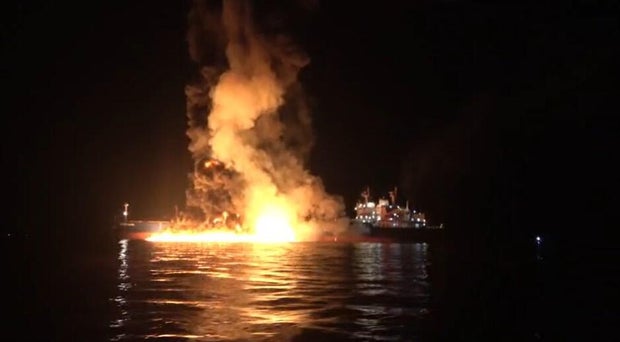
The British military’s U.K. Maritime Trade Operations agency said it received a report Wednesday night of an incident in the same location involving two tankers “struck by an unknown projectile.”
UKMTO said an official on “one affected vessel confirmed the attack had caused a fire onboard” and “reported that the crew have been evacuated and safe.”
“The CSO [Company Security Officer] of the second tanker involved has confirmed the vessel was struck and the attack has caused a fire onboard. All members of the crew have been evacuated. No environmental impact has been reported at this time,” UKMTO said.
The Director General of the Iraqi General Company for Ports, Farhan al-Fartousi said Thursday that a ship was attacked during a ship-to-ship cargo transfer about 30 miles off the country’s coast the previous night. He identified “the smaller tanker” involved as being Malta-flagged, and it was separately identified as the oil and chemical tanker Zefyros.
Iran says if U.S. or Israel attack its Gulf islands, it will “abandon all restraint”
Iran’s powerful parliament speaker Mohammad Bagher Ghalibaf warned Thursday that Tehran would “abandon all restraint” if the U.S. or Israel attack any of its islands in the Gulf.
“Any aggression against soil of Iranian islands will shatter all restraint. We will abandon all restraint and make the Persian Gulf run with the blood of invaders,” Ghalibaf declared in a social media post.
It was not immediately clear which islands he was referring to, but a recent report by Axios cited U.S. officials as saying that seizing Kharg, a tiny island only about 30 miles off Iran’s coast in the Persian Gulf, was on the table as the war in the Middle East spiraled.
CBS/AFP
Blasts heard over Jerusalem and Dubai, alarms blare in Bahrain, Kuwait and Saudi Arabia intercept drones
Blasts were heard over Jerusalem on Thursday after the Israeli military reported missiles fired from Iran, as Iran continued its campaign against Israel and Gulf states in response to the ongoing U.S.-Israeli offensive.
Explosions were also heard in downtown Dubai, in the United Arab Emirates, where the government media office reported a “minor drone incident” in the al-Badaa neighborhood, but said no one was hurt. It later said interception fire downed a drone and shrapnel hit the facade of a building on Sheikh Zayed Road, the 12-lane highway that runs through the heart of Dubai, but that there were no injuries in that incident, either.
A worker assesses damage to a building hit by a reported Iranian drone strike in Dubai’s Creek Harbour, in Dubai, United Arab Emirates, March 12, 2026. AFP/Getty 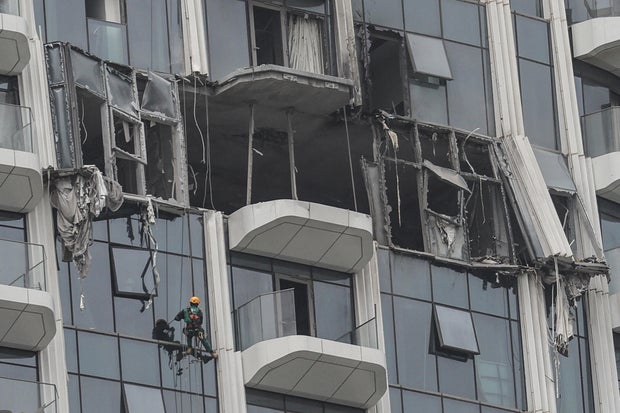
Kuwait International Airport was “targeted by several drones, resulting only in material damage,” according to the country’s official news agency, citing its civilian aviation authority.
Saudi Arabia’s defense ministry said it intercepted and destroyed two drones headed toward the Shaybah oil field in the southeast of the country, after earlier saying it had shot down one drone approaching a district housing foreign embassies and another in the country’s east.
The Interior Ministry of Bahrain, meanwhile, urged citizens to stay calm and head to “the nearest safe place” in the small Gulf state as alarms warned of more possible incoming Iranian missile or drone fire.
CBS/AFP
Oil prices jump back up and stocks sink again despite release of strategic reserves
Oil prices rose back above $100 and stocks sank Thursday as Iran’s attempts to hit supplies in the Middle East and bring down the global economy overshadowed a record release of strategic crude reserves by the International Energy Agency.
Stock markets in Asia closed down Thursday and European markets opened with losses as investors saw few signs the U.S.-Israeli war with Iran would end soon, despite President Trump’s repeated assurances that it would.
U.S. Energy Secretary Christopher Wright announced on Wednesday that the U.S. would release 172 million barrels of oil from its Strategic Petroleum Reserve, while the International Energy Agency — which has 32 member nations, including the U.S. — announced it would release 400 million barrels from its own reserves.
U.S. benchmark Brent crude, the international standard, was trading 5.3% higher at about $97 per barrel Thursday after hitting $100.50 on Wednesday.
In stocks, the future for the S&P 500 lost 0.4% while that for the Dow Jones Industrial Average was down 0.5%. Germany’s DAX lost 0.4% to 23,533.60 on Thursday, while the CAC 40 in Paris lost 0.7% to 7,982.64. Britain’s FTSE 100 sank 0.7% to 10,285.91.
In Asia, Tokyo’s Nikkei 225 closed down 1% at 54,452.96, South Korea’s Kospi lost 0.5% to close at 5,583.25, and Hong Kong’s Hang Seng gave up 0.7% to close at 25,716.76. The Shanghai Composite index shed 0.1% to 4,129.10 while in Australia, the S&P/ASX 200 dropped 1.3% to close at 8,629.00.
CBS/AFP
Israel announces another “wave of extensive strikes in Iran,” as expert says chance of regime change “very slim”
The Israeli military announced in a brief social media post Thursday the beginning of a new “wave of extensive strikes targeting the terrorist regime’s infrastructure across Iran.”
While President Trump has spoken repeatedly in recent days of ending the war “soon,” whenever he decides to do so, and even telling Axios on Wednesday that there was “practically nothing left to target” in Iran, neither Israel nor Iran have shown any inclination to slow their attacks.
One veteran Middle East analyst told CBS News’ Matt Gutman this week that the U.S. and Israel underestimated Iran’s capabilities, and that it is unlikely the regime in Tehran will collapse.
Danny Citrinowicz, a nonresident fellow at the Atlantic Council, a nonpartisan think tank, told CBS News he believes the chances of regime change are “very slim,” especially without the use of ground troops, which he said would be a potentially disastrous gambit.
“We had our hopes too high,” he said. “If somebody thinks that by air campaign, you can topple this regime, despite the fact that it’s weak, but it’s still very strong, I think we should think twice.”
3 crew members “believed trapped” on Thai ship attacked on Strait of Hormuz, owner says
Three crew members were “believed to be trapped” aboard a Thai bulk carrier that was hit by two projectiles on Wednesday while traveling through the crucial Strait of Hormuz, the vessel’s owner said.
Iran’s Revolutionary Guards said Wednesday they had struck the Thai-registered Mayuree Naree, as well as a Liberia-flagged vessel, in the strait because the ships had ignored “warnings.”
The Thai ship was struck Wednesday morning while transiting through the Gulf waterway after departing a port in the United Arab Emirates.
“The strikes damaged the Vessel’s engine room and caused a fire,” Thai transport company Precious Shipping said in a statement Wednesday evening.
“Three crew members are reported missing and believed to be trapped in the engine room,” it said, adding that authorities were working to rescue them.
The Omani navy had rescued 20 sailors and efforts were underway to rescue the remaining three, the Thai navy said Wednesday.
Thailand’s foreign ministry said all 23 crew members were Thai.
Indian crew member killed as 2 tankers attacked in Iraqi waters, authorities say
An Indian sailor was killed when a U.S.-owned crude oil tanker was attacked near the Iraqi port city of Basra, India’s embassy in Baghdad said Thursday.
The vessel, the Safesea Vishnu, sailing under the Marshall Islands flag, came under attack Wednesday while operating near Basra, the embassy said.
The remaining 15 Indian crew members were evacuated and are safe, the embassy said.
Farhan Al-Fartousi, from Iraq’s General Company for Ports, told Iraqi state television 38 crew members were rescued in all and the “search continues for the missing,” according to French news agency AFP.
A second tanker was attacked near Iraq as well, AFP reports.
The Iraqi State Organization for Marketing of Oil (SOMO) confirmed in a statement that two oil tankers were attacked, without providing details on how. An employee at Iraq’s Basra oil terminal told AFP it wasn’t clear “whether it was a drone attack or explosive-laden boats.”
SOMO said Maltese-flagged oil tanker Zefyros was attacked as it was getting ready to enter the port of Khor Al-Zoubair.
Both vessels had fires on board, the Reuters news agency reports.
CBS/AP
Italy says joint base for U.S.-led coalition in Iraqi Kurdistan hit and damaged
Italian Foreign Minister Antonio Tajani said there had been an attack on an Italian base in the Iraqi Kurdish city of Erbil, but there were no injuries at the compound, which also houses a U.S. base.
A Kurdish security source said drones were shot down over Erbil by international forces based at Erbil airport.
The commander of the Italian Camp Singara in Erbil, Stefano Pizzotti, told Italian television that “the type of threat is still being determined, whether it was a drone or a missile.”
Tajani condemned the attack on the base, which he said was “within a compound which includes other bases from other countries, above all Americans.”
“We don’t know if it was aimed at the Italians or at the compound in general,” he said, adding in a social media post that, “fortunately, all our soldiers are well and safe in the bunker,” though there was “some damage to the base’s infrastructure and equipment.”
CBS/AFP
Dozens of U.S. forces in Kuwait suffered serious injuries, sources say
An Iranian drone attack in Kuwait that killed six U.S. service members in the early hours of the war with Iran was more severe than has previously been revealed, with dozens suffering injuries including brain trauma, shrapnel wounds and burns, multiple sources told CBS News. At least one may require the amputation of a limb.
Sources described a chaotic scene in the aftermath of the strike on a tactical operations center at the Shuaiba port outside Kuwait City on March 1. Smoke quickly filled the building, making it difficult to rescue those inside.
Defense Department officials initially didn’t specify how many had been hurt in the Kuwait attack, but said on March 1 that five were seriously wounded and “several others sustained minor shrapnel injuries and concussions.”
The Pentagon has a process to notify wounded soldiers’ family members and seeks to shield them from learning from press releases about how extensive the injuries were. The military defines a serious injury as one that “requires medical attention, and competent medical authority declares that death is possible but not likely to occur within 72 hours.”
At least one American was killed in a separate strike in Saudi Arabia March 1. It is unclear how many others may have been injured in that attack.
On Tuesday, Pentagon spokesman Sean Parnell said about 140 American service members had been injured so far, without specifying where or when they were wounded. He said “the vast majority of these injuries have been minor, and 108 service members have already returned to duty,” with eight still listed as severely injured.
First week of Iran war cost U.S. about $11.3 billion, Pentagon tells lawmakers
Military officials told members of Congress in a briefing this week that the U.S.’s war with Iran cost around $11.3 billion in roughly its first week, according to sources familiar with the meeting.
That figure is a low-end estimate and does not include the build-up costs of moving assets into place ahead of the operation’s start on Feb. 28.
The estimate was first reported by The New York Times.
Sen. Chris Coons, the top Democrat on the Senate subcommittee that handles defense appropriations, told reporters Wednesday: “I expect that the total operating number is significantly above that.”
He said it would be a “fair guess” that the war’s daily cost exceeds $1.5 billion, though it varies day-to-day depending on military operations. The cost of replacing the munitions that have been used in the war is probably “already well beyond $10 billion,” he said.
The Delaware senator said he expects the Pentagon to ask lawmakers to pass a supplemental funding package for the Iran war. He did not specify how much money he expects the administration to request.
“Before I would even begin considering something like that, they owe us an accounting of how much has been expended,” said Coons. “We did have some lengthy exchanges about that yesterday. I am not satisfied with the information I’ve got so far.”
