Manchester United are currently second-bottom in the Premier League, a position that has sparked widespread disbelief. The club has long been seen as a fixture at the top of English football. Yet, the reality of their current form suggests a far more precarious situation. While many fans and pundits still believe a dramatic recovery is possible, the accumulating evidence points to a growing risk of relegation — one that is not merely speculative but grounded in tangible performance, player dynamics, and structural issues within the squad and culture. Source: football365.com.
Defensive Failures: The Worst in Europe
United have conceded 34 goals this season across all competitions — the most in Europe’s top five leagues. This includes 2.01 goals per match in the Premier League and -2.13 across all competitions. That figure is not just high; it is statistically anomalous. In the last decade, every team that was relegated from the Premier League averaged fewer than two goals conceded per game. United’s total surpasses that benchmark, even when compared to clubs that were spared from relegation but still struggled.
The team’s defensive record is worse than any relegated side from last season. This is not just a matter of individual errors; it reflects a systemic breakdown in communication, positioning, and recovery. The defensive unit has shown no consistency, with lapses occurring in both high-pressure moments and routine matches.
Key defenders are struggling. Matthijs De Ligt, returning from a year-long absence, looked rusty in his first Premier League appearance. His first touch in the match was delayed, and his positioning was erratic. This is not an isolated incident. De Ligt has been under immense pressure to recover, both physically and mentally, and his performance suggests a lack of integration into the current system.
Lisandro Martinez has been withdrawn from the squad for several matches, with no clear explanation provided. His absence is not due to injury, but rather a shift in tactical approach. Reports suggest he has expressed discomfort with the current coaching philosophy and has been reluctant to participate in training sessions. Leny Yoro appears visibly anxious during matches, often retreating to the edge of the pitch or failing to engage with defensive transitions. Ayden Heaven, a young defender, is not yet ready for first-team duties and has been rotated out of key matches.
Harry Maguire, the club’s most experienced defender, is aging. His pace and recovery are declining, and his ability to cover ground in high-tempo situations has diminished. At full-back, Diogo Dalot lacks confidence. His recent performances have been inconsistent, and he has been criticized for poor positioning and lack of aggression. Luke Shaw is injured and expected to be out for several months. Noussair Mazraoui is versatile but ineffective, often failing to provide a solid presence in one-on-one situations or in tight defensive zones.
Despite warnings from outside the Ineos group, senior figures Jason Wilcox and Omar Berrada have approved these selections. Their decisions appear to reflect a lack of urgency or strategic clarity. The club’s defensive strategy has not evolved in response to the growing threat of goals, and there is no visible plan to address the underlying issues.
January Transfer Window: A Critical Gap
United have 16 matches left before the January transfer window closes. They need two starting defenders and a central striker to stabilize the squad. This is not a minor adjustment — it is a fundamental requirement for survival. Without these changes, the team will continue to face mounting pressure from both the opposition and the public.
There are striker options available, though none match the quality of past United signings. The club’s transfer strategy has been inconsistent. Wilcox and Berrada have struggled to complete even one major signing in previous windows. Their approach appears to be reactive rather than strategic, with decisions driven more by short-term needs than long-term vision.
Defensive replacements are difficult to find. Selling a top-class defender would require a price that Ineos refuses to pay. The club prioritizes Premier League pedigree over performance or value. This means that even if a player is technically capable, they may be dismissed due to a lack of ‘brand recognition’ rather than actual on-field contribution.
Any potential signing would face a hostile environment. A player in peak form would see the club as a place to escape, not grow in. The culture at Old Trafford — one of privilege, expectation, and public scrutiny — makes it difficult to attract talent who are looking for a long-term, stable environment.
Player Self-Preservation: A Widespread Trend
Several players are already considering exits. This trend is not limited to one individual. After a heavy loss to Atletico Madrid, Lisandro Martinez criticized the coaching staff. His comments were sharp, suggesting a focus on personal protection rather than team improvement. The tone of his remarks — defensive, dismissive, and emotionally charged — indicates a clear desire to distance himself from a failing environment.
His remarks imply a desire to end his time at Old Trafford. As a captain who has carried the team since arriving seven years ago, Fernandes has carried immense responsibility. The fact that he now sees the need to leave suggests a deep disillusionment with the club’s direction and leadership.
Many players have long enjoyed privileges at United. The culture of being feted often overrides performance expectations. This creates a sense of detachment from accountability. When players are celebrated for their presence rather than their performance, they are less likely to take ownership of team failures.
Players may now see leaving as a rational choice. The toxic environment at Old Trafford has grown. The club’s failures are amplified by public scrutiny. Without a strong leadership message, the squad may continue to disengage. This undermines team cohesion and morale.
Team Morale: A Toxic Environment
United are the most visible club in English football. When they perform poorly, it generates headlines. This has created a culture of intense criticism. While some of this criticism is valid — particularly regarding defensive lapses and managerial decisions — the level of scrutiny exceeds that of other clubs. This environment contributes to a toxic culture where players feel they have no role in fixing the team.
Gary Neville, a former United player, has built his career on the club’s crises. His public commentary often reflects a narrative of decline. While his insights are valuable, they also reinforce a perception that United are inherently vulnerable. This narrative, though not entirely false, can be self-fulfilling — as players and fans internalize the idea that the club is destined to fail.
Players may feel they have no role in fixing the team. The lack of accountability is a key factor in the current downturn. When mistakes are blamed on individuals rather than on systemic issues, it fosters a culture of blame and disengagement. This is particularly dangerous in a team that already lacks confidence and cohesion.
Manager Mauricio Pochettino faces a difficult task. He must rebuild a squad that has lost confidence and cohesion. The team is now seen as a laughing stock by many fans and analysts. His ability to instill belief and structure will be tested not just by tactical decisions, but by the emotional climate within the dressing room.
Competitive Landscape: Who Else Is in Danger?
United and the other relegation contenders have collectively earned 24 points — more than any bottom-three group in the last decade. This is a significant figure. Historically, teams with eight points or fewer by this stage have been relegated 61% of the time.
Crystal Palace, currently bottom, is under new management. Thomas Frank may bring improvements. However, his impact will take time, and there is no guarantee that Palace will maintain momentum.
The promoted teams — including Brentford, Norwich, and West Ham — are competitive. They may not sustain their early form. In the past, these teams have shown resilience, but they have also been known to falter under pressure. United’s situation is not unique, but their failure to improve, combined with strong competition, makes relegation a real possibility.
There may be no derby to look forward to. The season could end without a single match of significance for United. The lack of a meaningful fixture against a top-tier opponent means that the team will not have a chance to prove itself in a high-stakes environment.
While the club has not yet been officially listed as a relegation threat, the five factors outlined here reflect a growing risk. The situation demands immediate attention — not just from the board or the manager, but from every level of the club’s operations. Without decisive action, the downward spiral may continue, and the possibility of relegation will become not just a concern, but a certainty.
For more on United’s transfer plans, see Man Utd Plot Sensational Transfer for Villarreal Defender Alex Freeman.
Sources & further reading
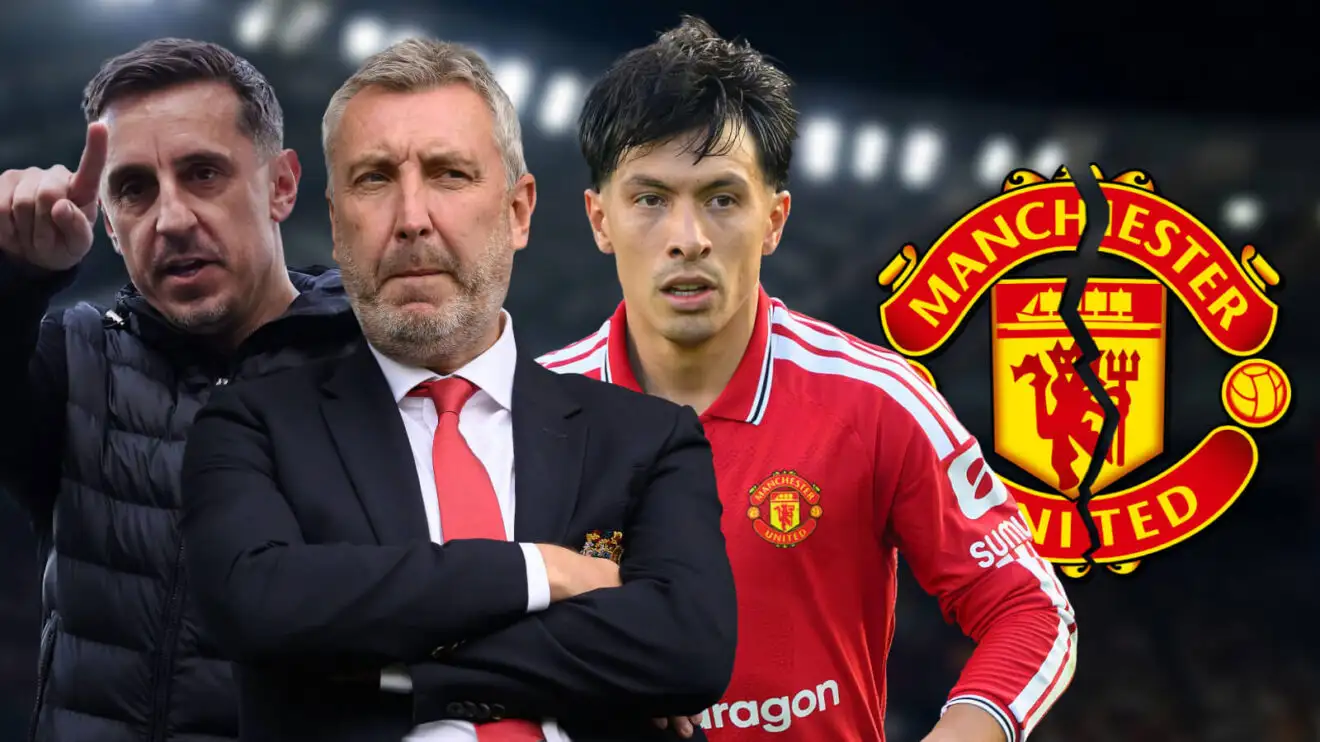
Featured image: Jason Wilcox, Gary Neville & Lisandro Martinez.. Via original publisher. Image source