
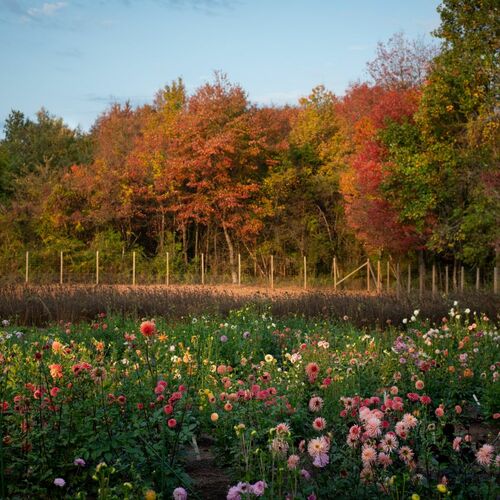
Lauren Grimm bought an 11-acre farm in Far Hills, New Jersey, with a house that hadn’t been updated in decades. She spent two years clearing invasive plants before tilling the heavy clay soil. Only then did she begin building Bewitching Blooms, a flower farm that opened formally this year. Source: finegardening.com.
From Finance to Farming
Grimm, 63, worked in finance for years in New York City. Gardening was always part of her life—she grew plants on rooftops and terraces. When she moved to the suburbs, her garden expanded until it ran out of space. Her early experiences were about personal connection, not production.
She found solace in the rhythm of planting, watering, and watching plants grow—something different from the fast-paced world of corporate finance. When she saw a chance to turn her passion into a business, she merged her financial skills with her love of plants.
She began with small-scale planting on her own land. Using her financial training, she budgeted for seeds, tools, and equipment. Over time, she realized that financial principles—like cost-benefit analysis and risk management—apply just as well to farming.
Flower farming doesn’t need massive infrastructure. A small plot can launch a growing business. This makes it especially accessible to women and other underrepresented groups. Many new growers are women, starting with modest plots and expanding as demand grows.
The Rise of Local and Sustainable Flower Farming
More people are choosing locally grown flowers. This reflects a broader shift toward sustainability and self-reliance. Consumers now seek products that are beautiful and environmentally responsible.
Debra Prinzing, founder of the Slow Flowers Society, has led this movement. The society promotes locally and sustainably grown flowers. It emphasizes reduced emissions, lower carbon footprints, and support for local economies. ‘I don’t think it’s a trend,’ she said. ‘I think it’s a cultural shift—and one that’s here to stay.’
Local farms like Bewitching Blooms offer fresh, daily-harvested blooms. This ensures peak freshness, vibrant colors, and strong stems. Imported flowers often arrive weeks after harvest. Locally grown flowers are picked just hours before delivery, preserving quality and reducing waste.
Buying local also strengthens community resilience. It reduces reliance on long-distance supply chains. These chains can be disrupted by weather or shortages. This is especially important in a changing climate where weather patterns are unpredictable.
Family Involvement and Shared Responsibility
Grimm’s journey has been shaped by her family. Her three sons, aged 25 to 29, visit the farm about twice a month. They help with planting, composting, and daily tasks. Their involvement is both practical and emotional.
They see the farm as a shared legacy. It’s a place where they can pass on their mother’s love of gardening to the next generation. Mark, the eldest, manages the farm’s Instagram account. His posts show behind-the-scenes moments—planting, harvesting, farm life.
These posts inspire many, especially young people exploring careers in agriculture or sustainable design. As the farm grew, the sons saw their mother becoming overwhelmed. The physical demands of farming took a toll.
They realized she needed more support. So they bought her a tractor. Grimm wept. ‘I thought I was in over my head,’ she said. ‘They believed in me enough to do that.’ The tractor wasn’t just a tool—it was a symbol of trust and shared responsibility.
Embracing the Uncertainty of Nature
Grimm walks the rows with her dogs and a cup of coffee. She checks daily what needs doing and what can wait. She no longer makes a to-do list the night before. She just doesn’t know what will happen.
‘You have to learn to let go,’ she said. ‘That’s been really hard for me.’ Nature doesn’t follow schedules. Weather, pests, and soil can shift suddenly. Even with best practices, storms or disease can hit unexpectedly.
For Grimm, this unpredictability isn’t failure—it’s growth. A successful farm adapts to change. It pivots when needed. It stays true to its purpose, even in tough times.
People Find Joy in the Fields
Event planners come not only to buy flowers but to draw inspiration from the colors in the fields. They gather ideas for arrangements, color palettes, and themes. The natural beauty of blooming dahlias or tulips is unmatched.
Local residents come to gather bouquets or pick flowers for dinner. Some just walk the rows to feel peace. On one visit, a family came with their daughter. Grimm watched her smile, take photos, and gather flowers by the armful.
Grimm loves seeing people experience the farm that way. ‘Just seeing how much joy people can find just walking through the rows of flowers,’ she said. ‘It’s not about the flowers—it’s about the moment. The moment when someone stops, breathes, and feels connected to something alive and growing.’
What Comes Next?
The house can wait. For now, the farm is the dream. ‘At some point, we’ll get around to having a working bathroom on the second floor,’ she said. ‘So I do not have to go down the hallway to brush my teeth.’
Bewitching Blooms is not just a business. It’s a place where people find peace. For Grimm, that peace is what makes the work worth it. The farm shows how small-scale, sustainable agriculture can thrive—by blending passion, family, and respect for nature.
For more on flower farming and growing cut flowers, see The Business of Flower Farming: The Lillie House. Learn how to grow cut flowers from seed at How to Grow the Best Cut Flowers from Seed.
Sources & further reading
Featured image: THUMBNAIL-1×1. Via original publisher. Image source
