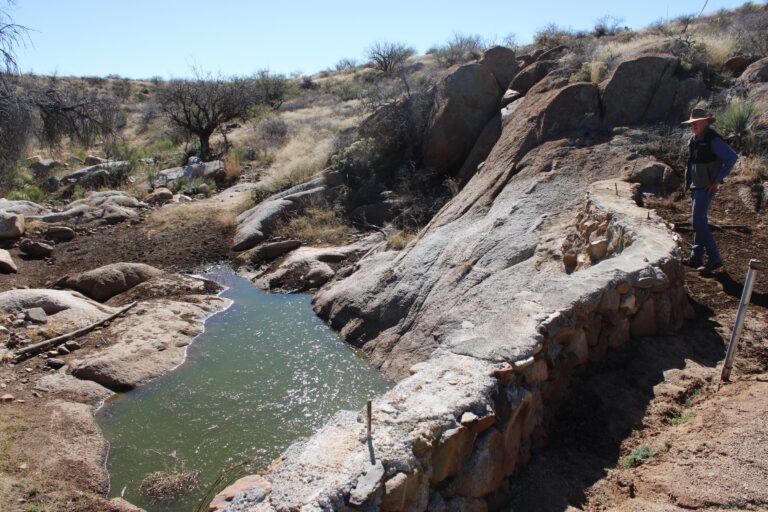
- On the border between the United States and Mexico, ranchers are struggling under shifting climatic conditions, including extreme drought and intense flooding.
- Small rock structures known as trincheras are an ancient method of slowing water flow, reducing erosion and improving subsoil quality, allowing life to rebound in degraded rangelands.
- A growing body of research indicates that rock detention structures like trincheras help improve drought resilience, increase biodiversity and water yields.
- In Sonora, a state dominated by private rangelands, momentum is growing to build these structures and adopt a wider range of “regenerative ranching” practices, as conservationists and ranchers work together.
CANANEA, Sonora — The day was windless. Long brown grasses speckled the landscape, and a stray tree erupted from the earth. The river channel was rusty, bone-dry. A pond that swells with summer rain glimmered on the horizon, but local rancher Eduardo Ríos Colores pointed toward the mountains, his finger tracing the route of a bone-dry streambed cutting through the landscape.
“There was a time when this stream didn’t exist,” he said. “There used to be a lot of trees, and all the trees prevented erosion from the water. But … the trees have been drying up.”
It was difficult to imagine the streambed swollen, rain-choked. But water in this region comes in all at once, in a deluge. As it races across the landscape, it forms deep channels like this one, creating sandy areas where new plants can’t grow. The land soon fails to support life, from the native grasses to migratory birds to the cattle that are the lifeline of ranchers like Ríos Colores.
“Many people say that when water flows, it shouldn’t flow straight,” he continued. “Those serve to divert the water … so the current flows like a snake.” He was referring to his trincheras — hundreds of small rock structures peppering the streambed. The small, permeable barriers go on for more than a mile, spanning the channel, each small weir composed of dozens of fist-sized rocks.
The trincheras, the Spanish word for “entrenchments,” were built in 2021 to slow down water, raising the water table and fanning rainfall across the landscape, preventing further erosion. Rich soil builds up behind the structures, a process that gradually allows grass to grow and life to return.

This strategy is not new. In northwestern Sonora and southern Arizona, U.S., similar structures have been used for thousands of years. As drought and intermittent flooding intensify under climate change, water detention structures like trincheras offer a simple, nature-based method of rehydrating degraded landscapes and fostering biodiversity. They’re also a place where ranchers and conservationists are finding common ground, part of a broader trend toward regenerative practices.
A dangerous confluence
Chronic drought has defined life for northern Mexican cattle ranchers in recent years. Ríos Colores has experienced its impacts firsthand. In 2025, he had no choice but to sell more than three-quarters of his herd.
“There was no grass; there was nothing,” he said. “We had to buy hay to feed the cows. It was no longer a business, and we had to sell them. Now, the land is practically empty, but there’s no grass.”
In late 2025, the state of Sonora emerged from a crippling multi-year drought that began in 2022. According to the National Oceanic and Atmospheric Administration (NOAA) in the U.S., 2024 marked the driest meteorological spring (March to May) in Mexico since record-keeping began in 1941, while the 2025 drought was declared “exceptional”< in most of Sonora’s municipalities.
While conditions have slowly begun to improve, calf crop production in Mexico decreased by 2% in 2025 after ranchers sold a record number of heifers to the U.S., primarily due to the cumulative effects of back-to-back droughts. Reservoir levels in Sonora hit 30-year lows, and neither grasslands nor water resources could support large herds.
Not having enough water isn’t the only concern for Sonoran producers. When rain does fall, it occurs in bigger, more severe events, a phenomenon that is also linked to a warming climate. In August 2022, torrential downpours during the North American monsoon led to flash floodsacross Sonora, while the southwestern U.S. recorded its ninth wettest monsoon season on record.
Ríos Colores said if he gets 25 inches of rain (about 635 millimeters) during the monsoon season, it’s a good year. “This season we got nine inches [228 mm],” he said. “In 2022, we got 85 inches [about 2,160 mm] of rain. Three times what we need.”
Separately, disease has harmed ranchers’ livelihoods. Most ranchers in northern Mexico export cattle to the U.S., where they fetch higher prices. But the spread of the New World screwworm fly (Cochliomyia hominivorax), a flesh-eating parasite, led the U.S. to close the border to live cattle in May 2025. As of July 2, the parasite has not been detected in Sonora, but Mexican ranchers have already seen their income dwindling.
Crossborder collaboration
“Little by little, the walls are filling up with subsoil,” Rios Colores said on the hilltop, as he inspected the trincheras. “For example, here it is very, very deep.”
Upstream from Ríos Colores, Zach Palma, Karen Aglaee Lopez Roman and Michell Cordova Morales were also inspecting the trincheras. Together, the three make up the Sky Island Alliance’s Ranchos Regenerativos team, supporting Sonoran ranchers in implementing sustainable practices that support both their livelihoods and native flora and fauna.
The nonprofit has been a fixture in borderlands conservation since its founding 35 years ago, focusing on protecting and restoring lands, wildlife and waters in the Madrean Sky Islands, a border-spanning ecoregion providing critical habitat for more than 7,000 plant and animal species.
Lopez and Cordova are Mexican citizens, both hired in 2025, with backgrounds in animal science and environmental science, respectively. Palma, the bilingual program director, commutes across the international border from Arizona. In recent years, the Sky Island Alliance has expanded its focus from wildlife conservation to partnering with the people living and working on the landscape, with a greater focus on Mexico since Palma started four years ago.

“There’s always been a connection and unity in some ways binationally,” Palma said. “The biggest question is, how do we achieve these goals in the same landscape but with very different human connections to the land?”
In the U.S., he said, the classic environmental narrative is more focused on public lands. While some of the team’s projects in Sonora are on public lands held by CONANP, Mexico’s National Commission of Protected Natural Areas, most of the ecologically valuable land in the region is occupied by producers. In Sonora, private rangelands comprise more than 80% of the landscape.
While Palma believes public lands are incredibly important, “we’re still going to those places as a visitor,” he said. “In this context where the producer is on the land, living with the land … that connection to the ecological system is more integrated.”
To Palma, this represents an approach that is in many ways further ahead than the often divisive conversation around ranching and environmentalism in the U.S.
“In Mexico, it’s just so much more on the table,” he said. “Like, let’s be friends first and see where this goes, and if it makes sense to collaborate, then of course we’ll collaborate.”
On Ríos Colores’ ranch there are more than 100 trincheras in the channel, built with support from the Sky Island Alliance, Mexican nonprofit Profauna, CONANP and multiple other academic and nonprofit partners.
A steady stream of Mexican and American conservation groups, students and volunteers arrive on the property to help with these projects. Beyond trincheras, volunteers have planted hundreds of native trees in degraded riparian areas. Workers installed wildlife-friendly fencing with barb-less top and bottom wires to keep cattle away from young vegetation. Contour lines slow water on hillsides. Pipes lace the awnings of every building, collecting rainwater. The teams cull invasive plants, making room for native ones that attract migratory birds.
Ríos Colores himself is lugging rocks, learning the science, driving workers around and rotating his cattle around the property. His ranch has also become a test site where different strategies are implemented, then shown to other ranchers, who may be hesitant to change their practices.
“[It] serves as an example … to see the difference between how they do livestock farming and how we do it, how we care for the environment, how we care for the pasture, how we care for the flora and fauna,” he said. “All of that is a chain that goes on. They are all connected and each one does its job perfectly.”
Ríos Colores was inspired to make a change after a job in town took him away from his property. Before, he rode his horse around every day, surveying the landscape. But when his visits became less frequent, he began to notice subtle changes.
“You start to pay more attention. You realize, for example, that your land is being overrun by invasive weeds,” he said. “That’s when you realize that your land is running out and that you have to do something if you want to keep it.”

Palma said that when he first started going down to Sonora, he only had a couple of ranch contacts. But their network has slowly expanded as the team has set up shop in nearby Cananea.
“The big thing is bringing other ranchers there so they can see it, and they trust Eduardo [Ríos Colores],” Palma said. “That’s so much more meaningful than scientists coming in.”
“Because of the climate factors, which are very tangible for ranchers, [they are] looking for solutions or looking for different ways to do things,” he said. “Now, we’re at a point where we have plenty of contacts, and we’re running into more capacity and funding [issues] to get that work done.”
Rediscovering ancient solutions
Nearly 150 miles north from Cananea, Laura Norman works from her office at the University of Arizona in Tucson.
Norman, a supervisory research physical scientist at the U.S. Geological Survey, is well-known in the borderlands. Over the past couple decades, she has conducted research across the region. In recent years, her studies have centered around the impacts of loose-rock structures like Rios Colores’ trincheras.
To her, these structures represent one of the biggest spots of hope in an often-grim scientific conversation around water in the region.
“When I first saw rock detention structures installed in a stream […] I described it as these oases […] that I had been dreaming about,” she said. “It’s like a soaking wet sponge with deep, rich sediment, very organic soils and vegetation all around.”
Rock detention structures go by many names and are often classified by size: “One rock dams” stand only one rock high (but encompass many rocks set side-by-side), while check dams or gully plugs are around three-feet high. Gabions incorporating wire cages and large “leaky weirs” are reinforced with concrete.
These structures slow and disperse water, while raising the water table, increasing infiltration and surface water for plants and animals. This reduces downstream sediment transport, which helps the soil to stabilize and riparian vegetation to rebound. Wetland-like “sponges” then form, trapping rich sediment and sequestering carbon. Wildlife returns, and a new cycle begins.
The full extent of these impacts is just beginning to emerge. The trincheras are beneficial for keeping floods at bay, but when Norman noticed the rich sediment piling up behind them, she and her team started exploring potential ecosystem impacts.
One of Norman’s studies focused on a watershed restored using more than 2,000 check dams in the Chiricahua Mountains. The check dams dampened peak flows, but flow volumes during a summer monsoon season were 28% greater overall compared to a watershed without restoration.
Notably, researchers conducted the study when some of the dams had been in place for 30 years, finding that most remained functional.

According to Norman, these methods are not new. For thousands of years, cultures like the Hohokam irrigated the arid landscape. The Trincheras people, ancestors of the modern Akimel Oʼodham (Pima) and Tohono Oʼodham Tribes, installed water retention structures in streambeds and on hillsides as early as 700 C.E.
“After 20 years of looking at structures, we started to think about those ancient structures that were there a thousand years [ago] on the same landscapes,” Norman said. “And you can see that the ancient people had been taking advantage of the fact that at the structures, you could grow food.”
A future of collaboration
On a ranch nestled among the Chiricahua Mountains of southeastern Arizona, rancher Josiah Austin picked his way up a small gully.
“This is blue grama, a really nice native grass,” he said, as he bent down to feel it between his fingertips.
“But you can see this Lehmann lovegrass. It’s a non-native from South Africa,” he said, pointing at a different plant.
Austin has owned Cienega Ranch since the 1980s. As conservation-minded ranchers go, he was an early acolyte. Some of his projects have been in place for more than 20 years, and their effects are visible across the property. Erosion-controlling berms are grown over, appearing as a series of small hills. Gully plugs, another form of loose-rock dam, hide among tall native grasses.
“I came out here and the first thing I saw was weather patterns,” he said. “It’s not unusual to get 10 to 20% of your annual rain in 45 minutes. And when that happens, it’s gone.”
Intuitively, he began placing loose rock structures, doing whatever he could to slow the torrent.

“This wash here, I had probably 15, 20 loose rock structures, maybe more, going up there,” he said, stopping to look at the small channel. “And they all got blown out in 2022.” Loose rock structures held up in smaller streams, Austin said. But in larger gullies, the only structures that survived the monsoon were anchored into exposed bedrock and reinforced with concrete, while still allowing water to seep through via holes or small pipes.
Austin pulled the truck to a stop at a small grove, then pointed to a pair of cottonwood trees. They’d once been dying, then he built berms above them, allowing water to trickle down the hillside and seep into the ground. Fifteen years later, he said, they started to come back to life, and more trees came in around them.
“What that tells me is that what we’re doing is working,” he said. “It tells me that if we did nothing, those cottonwoods … would be dead.”
While Austin was not immune to the effects of drought — he also sold cattle last year — his ranch serves as an example of what sustained restoration work can look like.
Austin has welcomed USGS researchers like Norman to his property to test the effectiveness of his measures. “I’m a firm believer in conservation easements,” he said. “It protects it for future generations and against future generations.”
To Norman, the borderlands is a place where divisions fall apart. Ríos Colores’ ranch is one example: A place where people from different backgrounds and different countries gather together with the shared goal of healing the landscape they love. Currently, more than 100 entities are working across the two countries to achieve that.
“We have this little thread we all hold that connects us,” Norman said. “We share the same storms in the sky.”
Banner image: Josiah Austin stands atop one of the structures on his property, which has been anchored into exposed bedrock and reinforced with concrete to withstand harsh conditions. Image by Rose Shimberg.
Citation:
Norman, L. M., Brinkerhoff, F., Gwilliam, E., Guertin, D. P., Callegary, J., Goodrich, D. C., … & Gray, F. (2016). Hydrologic response of streams restored with check dams in the Chiricahua Mountains, Arizona. River Research and Applications, 32(4), 519-527. doi:10.1002/rra.2895
FEEDBACK: Use this form to send a message to the author of this post. If you want to post a public comment, you can do that at the bottom of the page.
Cite this article
Rose Shimberg (2026). Ancient rock structures help restore biodiversity on the US-Mexico border. Mongabay Conservation news. DOI: https://doi.org/10.66709/news-323477
Credits