Nicolas Ghesquière was an 18-year-old fashion assistant at Jean Paul Gaultier when he took his first trip to New York in 1989. As it does on almost everybody, the city made a big impression. In a pre-show sit-down before Louis Vuitton’s cruise show he recalled the loft on Lafayette Street where he stayed, a late-night dinner at Florent, and a party he crashed at the artist Francesco Clemente’s place where Helmut Newton and Iman numbered among the guests. His eyes opened wide at the last bit: “New York!”
For his second Louis Vuitton cruise show in the city—the first was in 2017 at the Eero Saarinen-designed TWA Terminal at JFK—Ghesquière set out to recapture that youthful energy and expansiveness. In particular, he was captivated by the city’s uptown/downtown split and the shapeshifting and code switching that goes on between them. “I think it’s a question that will never be answered: this duality,” he said. “I love that and it was a very interesting starting point for the collection.”
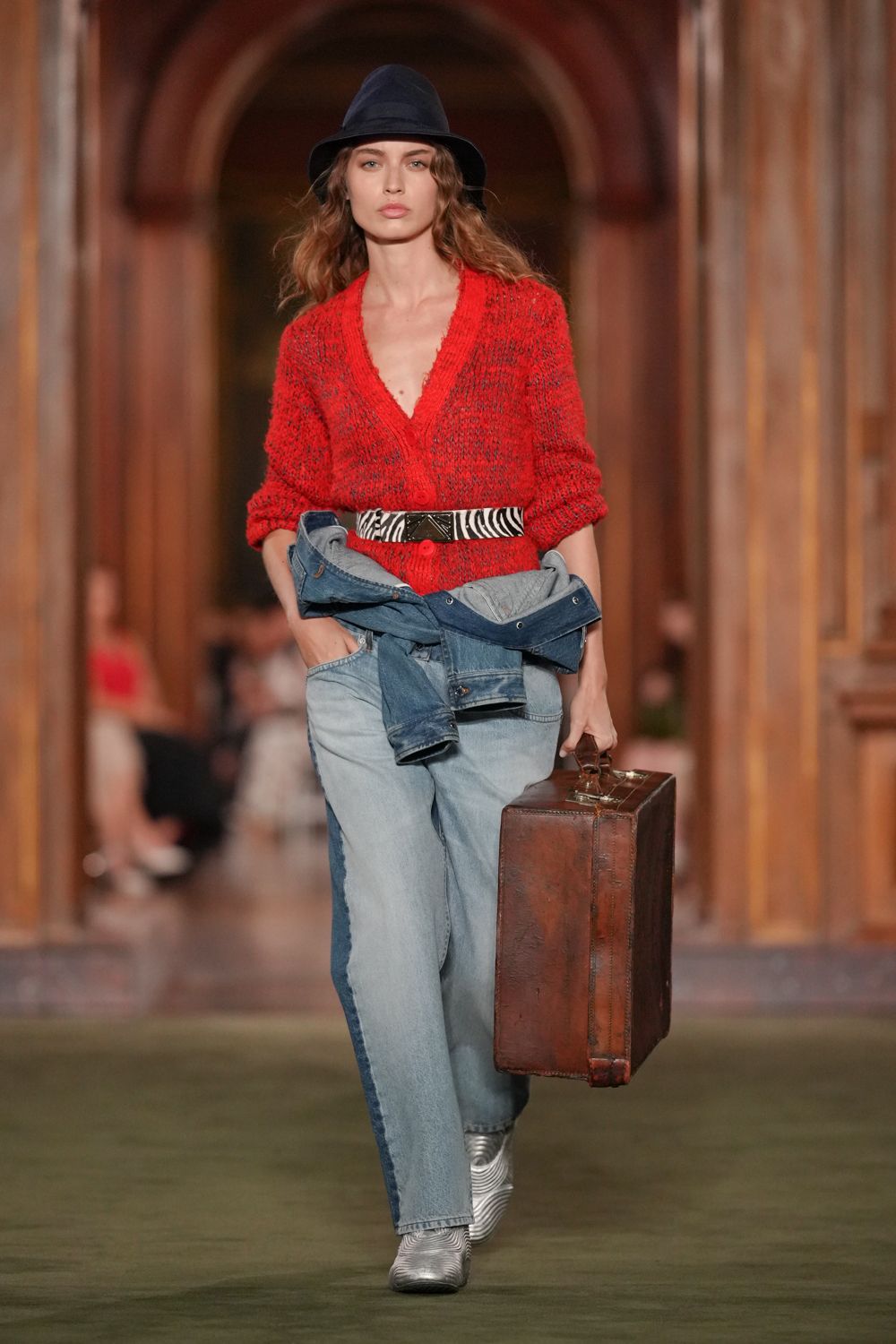
The show’s avatar and inspiration was the late Keith Haring, a graffiti artist-turned-fine artist, Ghesquière pointed out, whose work allowed him to do his own crossing of the uptown/downtown divide. “His message, [about] the accessibility to the exquisite, is really something very important to share still today,” he said. Only after he settled on the season’s direction, apparently, did he discover that Vuitton bid on and won a 1930 suitcase, faded to a fine brown veneer, by the company that Haring had tagged with a black Sharpie and given to a roommate back in the 1980s. A bag that will take you places, it accessorized the show’s first exit: a pair of denim overalls tied around the waist and a simple v-neck cardigan.
The venue was the Frick Collection, a Beaux Art home-turned-museum that was the subject of a recent Annabelle Selldorf renovation, and the recipient of a new three-year sponsorship from Louis Vuitton. So by the end of the show, that downtown girl in her quilted wrestling sneakers, crushed fedora, and everyday cardigan had traded places with a Gilded Age “cameo,” as Ghesquière called her, come to life, ruffles swirling around her neck above a bodice of lace and cut-out flowers. In between, he sent out other nods to Keith Haring, including an impressive hand-printed leather jacket; collectible bags designed to evoke yellow cabs and takeout containers; a top, cape, and dress in floral jacquard silk faille that echoed the Frick’s fabric wallpaper, all very pretty; and Alana Haim, making her runway debut, in an embroidered sundress.
There were none of the extremes of silhouette, nor the heavy felted fabrics of his out-of-time tromp across the mossy bog at the Louvre in Paris in March. Still, even back in town, Ghesquière remains as dedicated as ever to his own free-spirited—I heard someone call it kooky—vision. The idiosyncratic bricolage of Edwardian ruffles and 21st century spandex, of a lady-who-lunches skirt suit and origami folded minis, of satin boxer shorts and leather race car jackets, is the work of a designer resolutely, irrefutably not hemmed in.