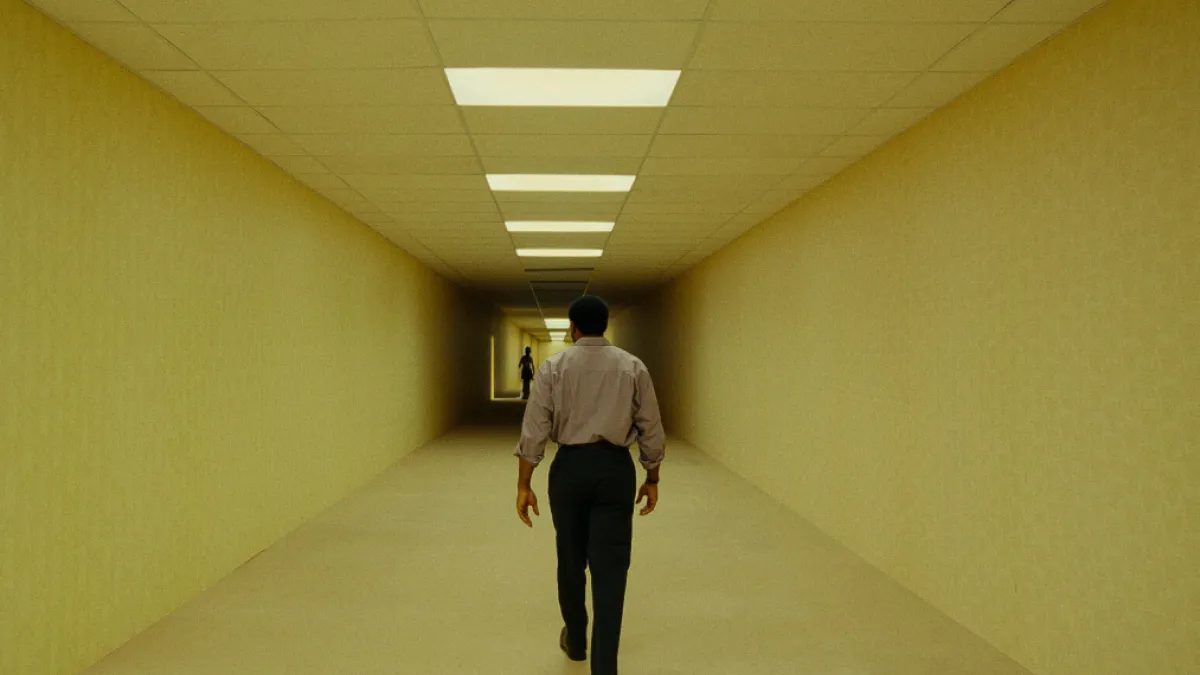
A 2026 horror film made for $10 million has earned nearly $400 million worldwide. It is one of the biggest successes in the history of its distributor, A24. The film follows a furniture store owner who discovers a doorway in his basement. It leads to a dimension of endless, distorted office rooms—spaces that feel both familiar and profoundly alien.
The Backrooms: From Internet Myth to Box Office Hit
The origin of the Backrooms lies not in a studio or script, but in the digital underground. In 2019, users on a paranormal-themed board of the forum 4chan began sharing images that, at first glance, seemed ordinary. One such image showed a bare, empty office room with yellow wallpaper, a stained carpet, and fluorescent lights buzzing at full volume. The image was taken in 2002 at a hobby store in Oshkosh, Wisconsin, during a renovation. It had been photographed by a passerby and later uploaded to the internet without any initial context.
It was an anonymous user who added the now-iconic caption: If you’re not careful and you noclip out of reality in the wrong areas, you’ll end up in the Backrooms, where it’s nothing but the stink of old moist carpet, the madness of mono-yellow, the endless background noise of fluorescent lights at maximum hum-buzz, and approximately six hundred million square miles of randomly segmented empty rooms to be trapped in. God save you if you hear something wandering around nearby, because it sure as hell has heard you.
‘Noclipping’ is a video game cheat that allows players to pass through walls and floors. The caption, though fictional, tapped into a real psychological mechanism: the human tendency to interpret ambiguity as threat. The image itself was mundane, but the language of the caption transformed it into a narrative of existential dread. Fans quickly began building a mythology around the Backrooms, creating a layered universe of ‘levels,’ ‘entities,’ and ‘dimensions.’ This digital folklore grew organically, with no central authority or creator.
In 2022, a 16-year-old YouTuber named Kane Parsons began producing a series of found-footage shorts that mimicked the aesthetic and tone of the original creepypasta. These shorts used handheld cameras, shaky footage, and ambient soundscapes to simulate the feeling of being lost in an unknown space. Over time, the shorts gained a cult following. By 2026, Parsons had directed the feature-length film, which brought the Backrooms from internet folklore to mainstream cinema.
Why Empty Rooms Fear Us More Than Monsters
Traditional horror often relies on jump scares or grotesque imagery—sudden, visceral reactions designed to trigger a physiological startle response. These are effective, but they are limited in psychological depth. The Backrooms, however, operates on a different principle: it evokes dread through ambiguity. Rather than showing a monster, it shows silence. Rather than presenting a threat, it presents a gap.
Psychologists Francis McAndrew and Sara Koehnke (2016) found that fear is most potent when the threat is ambiguous—when we don’t know if danger exists, or what form it takes. A coughing stranger may signal an infection, but it is not inherently creepy. Creepiness, however, arises when we perceive a being whose intentions are unknown and unpredictable. This is not a physical threat, but a mental one.
Researchers Jens Kjeldgaard-Christiansen and Mathias Clasen (2023) have proposed that creepiness stems from a disruption in mentalization—the ability to understand another being’s thoughts, emotions, and intentions. When we cannot read a being’s mind, we feel uneasy. The Backrooms exploits this by presenting subtle cues—distant footsteps, flickering lights, a shadow that moves just beyond view—that suggest something is present, but we cannot confirm its nature or purpose.
Architecture and the Fear of Being Lost
Our brains are wired to evaluate environments based on two key features: prospect and refuge. Prospect refers to an open view of the surroundings, allowing us to assess danger. Refuge refers to a place where we can hide or retreat. According to prospect-refuge theory, proposed by geographer Jay Appleton (1975), we feel safest in environments that offer both. The Backrooms violates both principles. There are no landmarks, no clear boundaries, and no exit. Every corridor leads to another, and every corner may conceal something.
Research by Alexander Diel and Michael Lewis (2022) found that buildings that deviate slightly from expected architectural norms—such as odd proportions, repetitive patterns, or distorted furniture—feel eerier. This phenomenon is known as the ‘uncanny valley’ effect. When a space appears familiar but slightly wrong, it triggers a deep sense of disorientation. The Backrooms uses this effect deliberately: the rooms are office-style, yet distorted in scale and layout, making them feel both ordinary and profoundly wrong.
What This Tells Us About Human Fear
The success of the Backrooms reflects a deep, universal human response to uncertainty. It is not merely a film about monsters or violence. It is a film about the absence of answers. The horror comes not from what is seen, but from what is implied—what we do not know, and what we cannot control.
For many viewers, the Backrooms is not a story. It is a mirror. It reflects the anxiety of modern life—of being alone, of not knowing where one is, of being unseen. In a world saturated with information and constant connectivity, the Backrooms offers a space of silence and isolation. It taps into a primal fear: the fear of being lost in a place with no way out, no one to help, and no answers.
As one psychologist notes, Creepiness arises when we sense an agent whose intentions we cannot read.
The film does not show a monster. It shows a gap. And in that gap, we see ourselves. The success of the Backrooms is not just about entertainment. It is a reflection of how we feel in a world full of unseen forces and unexplained spaces. It is a story about what happens when we stop knowing what is real.
That is what makes it so powerful—and so deeply human.
Original source: Psychology Today
Sources & further reading
Featured image: original publisher image. Via original publisher. Image source