Israeli political changes after the recent election are unlikely to reshape foreign policy toward Arab neighbors. Experts agree that Israel’s approach to Syria, Lebanon, Jordan, and Egypt will remain largely unchanged.
Foreign Policy Is Expected to Stay Stable
Both Benjamin Netanyahu and Gadi Eisenkot represent similar positions on key security issues. Egyptian politician Mostafa Bakry says Arab populations don’t expect a major shift in Israel’s foreign policy.
Beth Oppenheim of the European Council on Foreign Relations notes that an Eisenkot-led government would be politically fragile.
But foreign policy would not change.
Palestinian Statehood Remains Out of Reach
Support for a Palestinian state has collapsed across most Jewish parties. All mainstream parties, except one, support or accept settlement expansion and oppose a Palestinian state on the 1967 lines.
Even Gadi Eisenkot has said there is no Palestinian state and none will be established under his government. This reflects a deep political consensus, not just personal views.
Mairav Zonszein of the International Crisis Group says a new government might slow down Israel’s aggressive actions in the past four years. It could reduce religious messaging, ease demands on Hamas disarming in Gaza, and move forward with the 2025 ceasefire — though implementation has been weak.
Settler violence in the West Bank remains a serious issue. Elizabeth Tsurkov of the Middle East Policy Council says it lacks broad support and damages Israel’s global image. She believes it can be suppressed and that a new government might take steps to address it.
Normalization with Saudi Arabia Faces Continued Hurdles
Saudi Arabia has made it clear that Palestinian statehood is a prerequisite for normalization with Israel. This stance is both religious and political.
At a meeting of foreign ministers from Saudi Arabia, Pakistan, Turkey, and Egypt, the four co-signed a statement calling Israel the ‘fundamental source of instability’ in the region.
Despite public statements, behind-the-scenes diplomacy between Israel and Gulf states continues. Analysts say a less hardline Israeli government could make such backchannel talks more feasible. This might allow low-profile cooperation on trade, security, and economic issues.
Israel-Syria Security Talks May Resume
Israeli troops have operated as far as 1,160 kilometers into Syria. They conducted 1,996 ground operations in southwest Syria between January and September this year.
Before the election, any withdrawal from Syria was seen as a political defeat. Ksenia Svetlova, a former Israeli parliament member, says a centrist government might reconsider this stance.
Many stakeholders in such a government have previously supported a security agreement with Syria. This could revive diplomatic ties and reduce spillover risks.
Still, the far right opposes any withdrawal, seeing it as a threat to national security. The 1974 disengagement agreement remains a key reference point, though Israel has refused to return to its boundary lines.
Lebanon Seeks More Diplomatic Engagement
Lebanese officials prefer an Eisenkot-led government. They believe it would be easier to negotiate with than Netanyahu.
Israel and Lebanon are still negotiating an Israeli withdrawal from southern Lebanon. Israel claims a ‘buffer zone’ to fight Hezbollah. Lebanon sees this as an invasion of its territory.
Lebanese circles believe Eisenkot would be easier to work with than Netanyahu. A 2022 maritime agreement shows past cooperation, allowing shared control over offshore zones.
Despite Eisenkot’s ‘Dahiyeh Doctrine’ — which calls for asymmetric attacks in southern Beirut — Lebanon still views him as more manageable.
Israeli operations in southern Lebanon have continued, including the destruction of entire villages. This practice remains controversial and violates international norms.
While domestic reforms may occur, regional trends remain unchanged. Palestinian statehood remains taboo. Without a diplomatic path with Palestinians, violence in Gaza and the West Bank will likely rise. Normalization with Saudi Arabia will remain off the table.
Arab neighbors remain cautious. They see little hope for real policy change. The election outcome reflects continuity, not transformation. The region continues on a path of cautious diplomacy with few breakthroughs.
- Netanyahu’s security doctrine remains widely supported.
- Settlement expansion and Palestinian statehood are still normalized.
- Lebanon sees potential for improved relations with Eisenkot.
- Syria may see renewed talks over a security agreement.
- Normalization with Saudi Arabia remains conditional on Palestinian statehood.
More details on the Israeli election and regional dynamics can be found in the original report at DW.com.
Sources & further reading
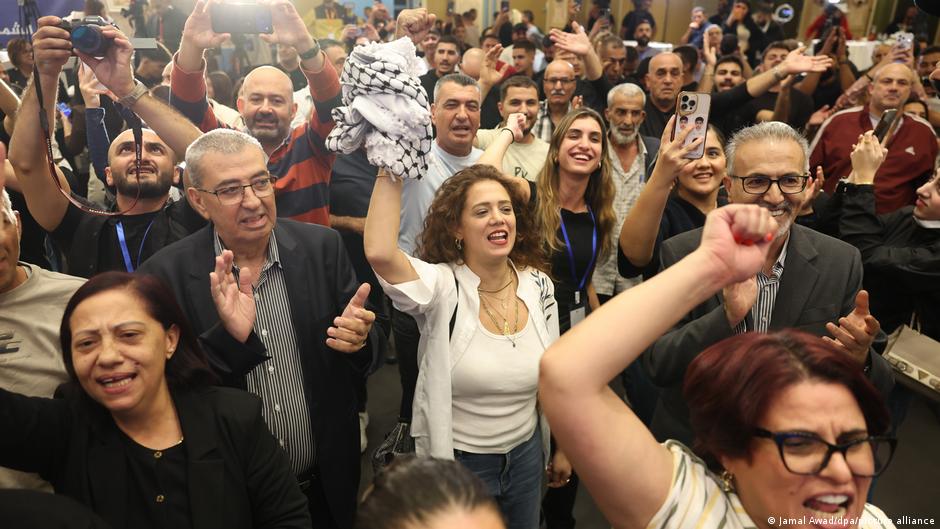
Featured image: Supporters of Palestinian candidate Yousef Jabareen of the Joint List party celebrate early exit poll results, at the party's headquarters in Nazareth, during Israel's legislative election.. Via original publisher. Image source